
Free Practice Abstract Reasoning Tests
Updated November 15, 2023


Abstract reasoning questions test your ability to identify patterns presented in diagrammatic form and are not dependent on your knowledge of English or maths.
Practice for Any Job Assessment Test with JobTestPrep
Because they are visual questions and are independent of language and mathematical ability, they are considered to be an accurate indicator of your general intellectual ability as well as being ‘culturally fair’.
Abstract reasoning ability is believed to be the best indicator of fluid intelligence and your ability to learn new things quickly.

These questions use symbols arranged in a straight line or in a pattern and you are required to identify the missing symbol or the next in the sequence.
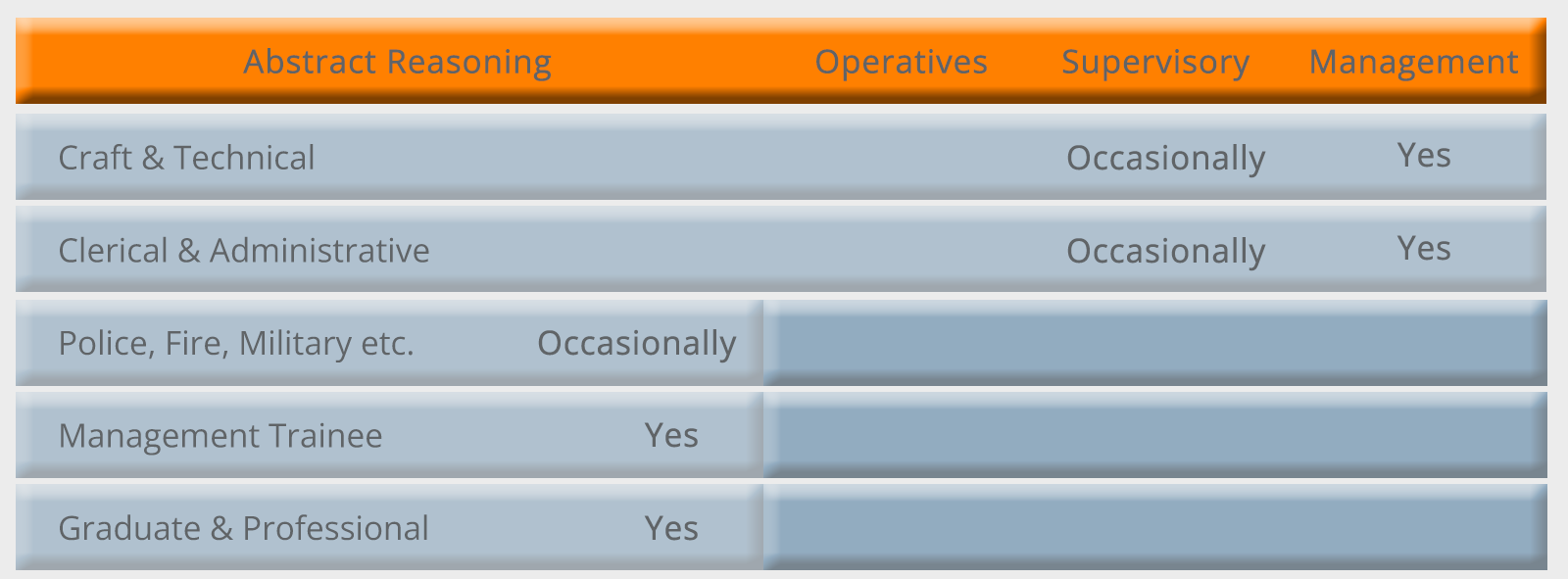
Abstract reasoning ability questions are invariably multiple-choice and strictly timed. These types of question are very commonly used in graduate and managerial selection.
This sample question paper contains 25 questions and has a suggested time limit of 20 minutes. The questions are presented in Letter/A4 format for easy printing and self-marking.
If you need to prepare for a number of different employment tests and want to outsmart the competition, choose a Premium Membership from JobTestPrep.
You will get access to three PrepPacks of your choice, from a database that covers all the major test providers and employers and tailored profession packs.
Prepare for Any Job Assessment Test with JobTestPrep
An abstract reasoning test is most often used as part of the recruitment process as a pre-employment screening assessment.
As an aptitude test, it assesses candidates on their fluid intelligence and is considered to be a great predictor of future success in roles that require quick thinking and problem solving.
It does not measure learned knowledge and does not need any verbal or numerical skills to answer, which makes it an unbiased and culturally inclusive way of assessing applicants based on critical thinking skills alone.
Abstract reasoning tests are usually structured as diagrammatic questions with multiple-choice answers. The diagram is made up of a series of shapes, images, or symbols that form a sequence, and you need to find the missing part of the diagram or the next one in the sequence.
To do this effectively, you will need to quickly identify the rule that governs the pattern and choose the right answer from the multiple-choice options given.
By demonstrating that you can spot patterns and draw rational conclusions from unfamiliar information, the recruitment team will know that you have the aptitude for critical thinking and logical reasoning.
As with many other aptitude tests, practice makes perfect for increasing your abstract reasoning skills.
You can improve your abilities by completing different types of puzzles, like Sudoku or logic games – and there are several ‘brain training’ apps that you can get on your smartphone that you will find useful for getting better at recognizing patterns and thinking logically about patterns.
If you know the different patterns that could be used in creating the sequence, you will have a frame of reference to use when you are looking at the questions. For the most part, you will find that there are only certain ways that the images in the diagram can change, so look out for:
- Mirroring
- Increase or decrease in size
- Numbers
- Symmetry
- Rotation
- Positioning
One of the most challenging parts of an abstract reasoning test is unfamiliarity – so you can improve your chances by getting comfortable with the way these tests are structured by practicing. If you know the publisher of the assessment you are taking, you can find tests designed to be similar, but even if you don’t know who makes the test, they tend to be mostly the same in layout anyway.
When you are considering practicing abstract reasoning for job tests, the first place you should look is the website for the company for which you have applied. Here you will find out more about the application process and hopefully information about who the publisher of the test will be.
If you cannot find the information, you can look at sites like this and Wikijob, which have lots of information available not only on abstract reasoning tests but also about applying for different companies too – and there is likely to be helpful information on there.
For more free practice tests, JobTestPrep has a range of publisher-specific tests and Prep Packs you can use to give yourself the best chance of success and be as prepared as possible.
If you want to prepare yourself in the best way for abstract reasoning tests, one of the most important things you can do is practice.
While aptitude tests and especially abstract reasoning tests are not about learned knowledge or education, you can improve your skills and your chances of success by becoming familiar with the test itself and the way the questions are presented.
The content of an abstract reasoning assessment is broadly similar across publishers, so practice tests will give you a real understanding of what is expected of you.
Keep track of your performance across these practice tests so you can see how much better you are getting at the assessments.
You can also practice in your everyday life through logic games, completing puzzles like Sudoku, and even installing brain training apps and games on your smartphone.
Abstract reasoning tests, like other aptitude tests, are not based on academic knowledge or learning.
They are designed to be independent of verbal and numerical skills, so traditional study and revision might not help you.
However, you can improve your chances in the abstract reasoning test through practice and knowledge of the typical ways an assessment is structured and the type of questions that are asked.
You can take free practice abstract reasoning tests online to become more comfortable and familiar with the structure of the test, answering questions quickly and spotting the different patterns in the sequences.
These might include:
- Increasing or decreasing size
- Rotation
- Symmetry
- Mirroring
- Changing direction
- Numbers
Practice really does make perfect when it comes to getting comfortable finding patterns in unfamiliar information and making logical decisions.
Being good at abstract reasoning means that you are good at making rational decisions based on limited and unfamiliar information by spotting patterns.
For an employer, this aptitude is useful in positions where fast and accurate decision making is important.
Fluid intelligence – the ability to learn and adapt – is an excellent predictor of future success in a role.
People who have good abstract reasoning skills can work under pressure, work quickly and think critically – even when given unfamiliar or limited information to use.
Your raw score at the end of the abstract reasoning test is usually compared against a ‘norm group’ of other test-takers, which creates a percentile score.
The percentile describes your performance in comparison to the performance of others, and it is usually this that is used as selection criteria in the recruitment process.
A good percentile score puts you above the majority of test-takers. If you score in the 50th percentile, you will be about average – performing better than half of the test-takers, but less well than the other half.
Each company and recruitment team will have a specific percentile score that must be met for you to be taken further in the application process, and for roles that are particularly attractive and have lots of applicants, this could be as high as the 90th percentile.
To guarantee your spot moving forward in the recruitment process for your dream role, you need to achieve the highest score you are capable of in the abstract reasoning test, so make sure you take the right steps to practice and prepare.
When you are getting prepared for an abstract reasoning test, you should try and find out who the publisher of the test will be.
There are often practice tests available on their website which are a terrific way to get a real idea of what you are facing.
For more practice tests, JobTestPrep offers relevant practice assessments based on different publishers and different employers.
If you don’t know the publisher, then any abstract reasoning practice test will help you hone your skills – they are all much the same in terms of structure and content.
An abstract reasoning test is often used as part of the recruitment process for many roles across several sectors, and each employer will have different criteria for success.
The scoring system for most abstract reasoning assessments presents your results as a percentile, which compares your performance to other test takers – other people going for the same role or a ‘norm’ group made up of previous test-takers.
What this means for you is that it is possible to fail the abstract reasoning test if you do not achieve the mark that the recruitment team is looking for.
To give yourself the best chance of success in getting through the abstract reasoning test, do as much preparation and practice as you can.
Abstract reasoning tests are an assessment of fluid intelligence – your ability to make quick, rational decisions based on limited data by spotting patterns.
There are no verbal or numerical skills needed to complete the test and be successful, and it does not consider educational level or learned knowledge.
This type of assessment is often a part of a typical IQ test, as fluid intelligence is important in measuring general intelligence.