
What Are Cognitive Ability Tests? (2026 Guide)
Updated November 6, 2024


- A List of Cognitive Ability Tests available for Practice in 2026
- Common Characteristics of Cognitive Ability Tests
empty
empty
empty
- History of Cognitive Ability Tests
- Commonly Used Cognitive Ability Tests
empty
empty
empty
empty
- Why Are Cognitive Ability Tests Used and By Whom?
empty
- What Does a Cognitive Ability Test Measure?
empty
empty
empty
empty
empty
empty
- How Are Cognitive Tests Administered?
- How to Prepare for a Cognitive Ability Test in 2026
- How to Improve Cognitive Ability in 2026
empty
empty
empty
empty
- Final Thoughts
A List of Cognitive Ability Tests available for Practice in 2026
Cognitive ability tests are a form of psychometric test to measure and assess intelligence. They are commonly used in pre-employment screening as a way to give an overview of a candidate’s strengths and weaknesses over a broad range of aptitudes – to predict the success of the candidate in a role.
Measuring general intelligence or cognitive ability through a range of tests that include logic, reasoning and problem-solving is simple and easy for a recruiter to administer to a large number of candidates and can reduce the hiring pool to a more manageable size.
Cognitive ability tests are most often used in hiring alongside resumes and qualifications, but they can also be used once an employee is in post as a training tool or for promotion.
Depending on the industry, a cognitive ability test can include questions about numerical ability, vocabulary, logic, spatial awareness, recognizing patterns and mechanical reasoning.
Common Characteristics of Cognitive Ability Tests
Although every test publisher may create a slightly different cognitive ability test battery, they do share some characteristics.
Variety of Topics and Abilities
In a cognitive ability test, the questions are likely to move from one topic or subject (and back again) throughout the test, so there are no defined ‘sections’ dealing with one aspect of ability.
This can happen from question to question, and there may be certain questions that are actually testing more than one ability at a time.
Time Constraints Make the Tests Difficult
The timing of the tests tends to be the most challenging aspect – cognitive ability tests are meant to put pressure on you and get you thinking and reacting quickly, so they offer a relatively short time to answer quite a few questions.
The Questions Are Not Hard... but the Test Is
Cognitive ability tests are meant to be assessments of general intelligence, and as such, they require no specialist or job-related knowledge.
Instead, they are looking for inherent aptitude to predict whether a candidate would be a suitable hire, would learn well and would perform well in the role.
The questions in a cognitive ability test, therefore, are not hard. It is the pressure from the timing and the unfamiliar circumstances that make them difficult. This is why practice is so important.
History of Cognitive Ability Tests
Cognitive ability, or general intelligence, was first tested for in the early 19th century. While these early tests sought to find a correlation between intelligence and performance, they were often highly inaccurate and didn’t stand up to scientific scrutiny. Trained psychologists were needed to create something more standardized.
In 1904, Charles Spearman began stating that there was a correlation between good performance in one aptitude and good performance in another. He described a ‘general mental ability’, which is essentially what we think of as intelligence.
Another founding father of the cognitive ability test is William Stern who, in 1912, developed the Intelligence Quotient (IQ) to measure a child’s mental age.
Since then, many assessments described as ‘cognitive ability tests’ have been developed throughout the world. They are considered an almost necessary part of the sifting process for roles in many industries – from entry-level and graduate schemes to management and C-suite roles.
Commonly Used Cognitive Ability Tests
Throughout the world, cognitive ability tests are used in pre-employment screening, role training and promotion decisions.
There are a few companies that make some of the most well-known tests of this type.
Predictive Index Test
Predictive Index makes a number of tests, but the Predictive Index Cognitive Assessment (PICA) is the one most often used to make an unbiased assessment of abstract intelligence.
Fifty multiple-choice questions are available to answer in just 12 minutes.
The objective results are used in the recruitment process for a number of companies such as:
- IKEA
- Dell
- Microsoft
Practice Cognitive Ability Test with JobTestPrep
McQuaig Mental Agility Test
The McQuaig Mental Agility Test measures general intelligence and the speed of thought processes.
Fifty questions are available to answer in just 15 minutes. It assesses reaction speed in answering questions on mathematics, reasoning and verbal understanding.
Employers that use the McQuaig Mental Agility Test include:
- Caffe Nero
- Mitie
- Highland Spring
Try a McQuaig Mental Agility Test
Wonderlic
Wonderlic created the Wonderlic Personnel Test (WPT-R).
This is the most popular one in its battery because it is very quick and can be used in the early part of the recruitment process, usually for graduate-level roles.
The full test asks 50 questions in 12 minutes, while the Quicktest asks 30 questions in just eight minutes, based on fact, logic, pattern recognition, verbal reasoning and word problems.
This test is used by employers like:
- MENSA International
- Apple Chevrolet
- Gulf Coast Commercial Group
Try a Wonderlic Personnel Test
Revelian
Revelian is an Australian testing publisher that has produced a number of tests for cognitive ability, reasoning, personality and work preferences.
The Revelian Cognitive Test (RCT) has up to 51 questions of increasing difficulty to be answered in 20 minutes.
It also offers two game-based cognitive ability assessments that use role-playing and puzzle-solving to measure cognitive ability.
As this is an Australian publisher, RCTs can typically be found as part of the recruitment process all over Australia but, in particular, the following organizations use them:
- The Australian Government
- Manpower
- Deloitte
Why Are Cognitive Ability Tests Used and By Whom?
Through extensive psychological research, it is understood that cognitive ability is an excellent indicator of great performance in work. This makes it an effective way to screen potential candidates, especially for graduate and managerial roles where situations are likely to call for confident decision-making and abstract thinking.
Although cognitive ability tests are not meant to be hard in themselves, they are difficult due to the time pressures and the number of abilities that are being tested.
Practice will help to make sure that you get through to the next round of the application process. However, a good recruiter will use the tests in combination with other factors – like a great resume and cover letter, as well as qualifications and experience – to make a hiring decision.
Each cognitive ability test will have a different scoring range, and the pass marks will depend entirely on the business and its standards – so there is no ‘one size fits all’ score that will land you the role.
Instead, aim high and answer as many questions as you can to give yourself the best chance.
If you need to prepare for a number of different employment tests and want to outsmart the competition, choose a Premium Membership from JobTestPrep.
You will get access to three PrepPacks of your choice, from a database that covers all the major test providers and employers and tailored profession packs.
What Does Scoring Highly on Cognitive Ability Tests Mean?
There are several skills and qualities that a cognitive ability test can measure.
Those who score highly on them are likely to be:
- Good at adapting to new working environments
- Able to make intelligent and difficult decisions
- Productive
- Able to apply new knowledge
- Easier to train
- Able to work well under pressure
- Able to quickly shift from one thought process to another
- More capable of abstract and lateral thinking
- Better at planning and organization
What Does a Cognitive Ability Test Measure?
Each cognitive ability test will ask questions on a number of subjects, measuring the ability of candidates in various areas. These are not subjects that require specific knowledge or revision, just a basic understanding – so they test the candidate’s general intelligence.
Verbal Reasoning
Verbal reasoning questions involve a passage of text that may or may not be relevant to the job role you have applied for. You will be asked questions about this passage of text and will need to quickly read, understand and analyze the text to find the relevant answer(s).
The verbal reasoning questions are often multiple-choice format, with a statement that you must decide is either true or false, or that there isn’t enough information to make a decision.
Here the most common verbal reasoning questions you might come across:
- Comprehension – Comprehension questions test your understanding of the text provided. Questions might ask about the argument made in the text.
- Vocabulary – In vocabulary questions, you might be asked to find the definition of a word or provide synonyms and antonyms.
- Analogies – Analogies in verbal tests are looking for the specific relationships between words. They ask candidates to find logical connections.
“In Australia, timber flooring is a popular flooring option, especially in the Queensland area. Timber offers a natural finish to a room that lends itself to both modern and traditional styles, and with the right upkeep (including regular sanding and polishing) it can look as good as new even many years later. However, for many renovators and home builders, the opportunity to purchase timber-look tiles gives even more value for money as they need no maintenance and are easier to use in conjunction with options like underfloor heating and cooling systems. The tiles now offer a level of realism that would have been unimaginable just ten years ago – and this means timber-look tiles are growing in popularity.”
Is the following statement about this passage true, false, or is there not enough information to decide?
'Timber flooring needs no upkeep.'
a) True
b) False
c) Not enough information
Numerical Reasoning
In the numerical reasoning questions, you will be presented with some numerical data – like a table, graph or problem, and need to read, understand and analyze the information before solving the problem.
You do not need a degree in mathematics for numerical ability tests, just a basic understanding of functions like percentages, fractions and ratios.
- Mathematical word problems – Word problems can seem complicated because of the way they are written, but they usually require an uncomplicated sum that shouldn’t need too much consideration.
- Number series – You might be asked to find a pattern to work out the next number in a series. It might be a missing number in the middle of a pattern, or at the end.
- Basic mathematics – A rudimentary knowledge of math should be sufficient for success in the mathematical questions of the cognitive ability test. In almost all of these tests, you will not be allowed a calculator during the assessment so practicing quick mental arithmetic will help you make the most of your time.
Find the next number in this series:
3 | 16 | 29 | 42 | ……
a) 56
b) 52
c) 55
d) 49
Try a Numerical Reasoning Test
Logical Reasoning
Logical reasoning can be presented in many forms, but each one is testing the same thing – your ability to draw logical conclusions from limited information.
They can be shapes, pictures or word-based, and will often need you to find patterns and rules to make logical decisions.
- Deductions – Deductive questions are often posed in the form of a word problem, detailing a series of stated facts. These can be answered as true/false/cannot say.
- Syllogisms – You may be presented with two statements of truth and need to logically deduce if a third statement is true, given the provided information. There is a major premise and a minor premise, which should lead to a conclusion.
All cats are animals.
All animals have teeth.
All cats have teeth.
Given the first two statements, is the third statement:
a) True
b) False
c) Cannot say
It is worth mentioning here that at no point in the cognitive ability test should you bring any outside information in. The questions should be answered based only on the data you are given in the question.
Abstract Reasoning
Like other reasoning questions, you are expected to understand and analyze information to answer questions. In abstract reasoning, these are usually shapes or images rather than words or numbers.
- Matrix – Patterns or shapes may be presented in matrices, and you are required to find the missing item in each matrix.
- Next in series – A series of shapes or images are presented, and you need to find the pattern in order to work out what comes next out of the provided multiple-choice answers.
- Odd one out – Several different images or shapes are presented, and you need to choose which one is the odd one out.
Which image is the next in this pattern?
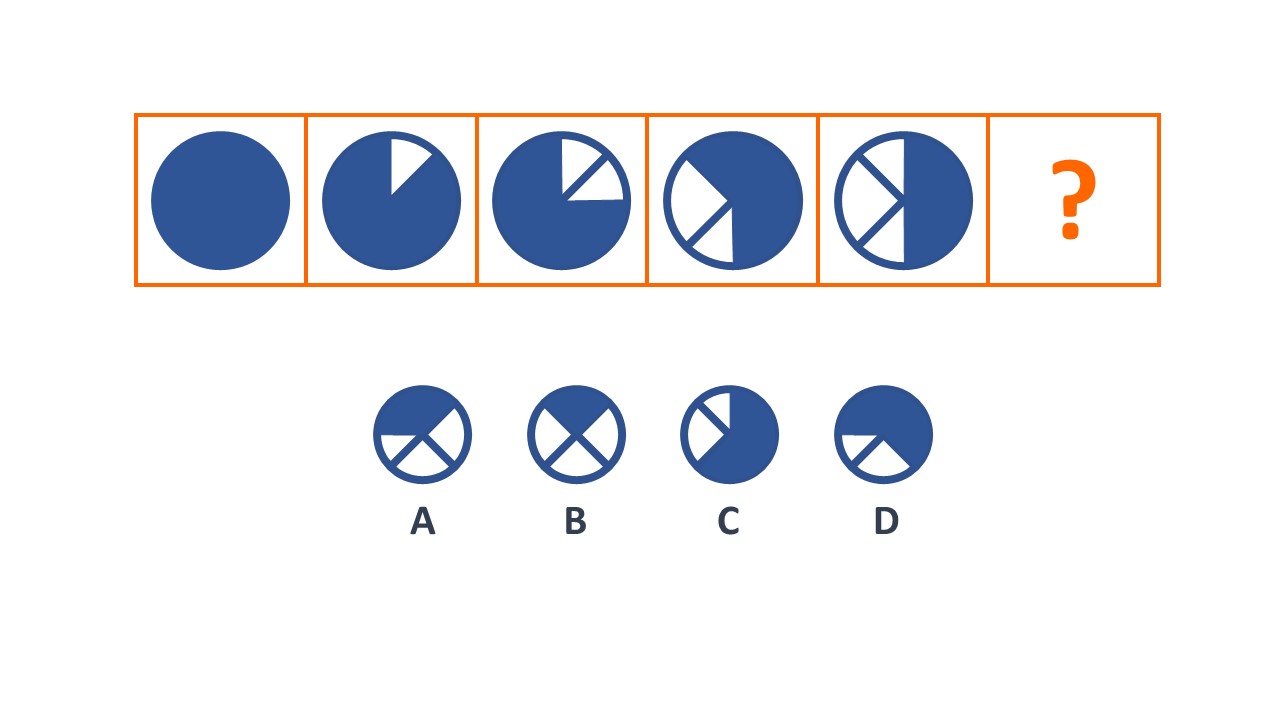
Try an Abstract Reasoning Test
Spatial Awareness
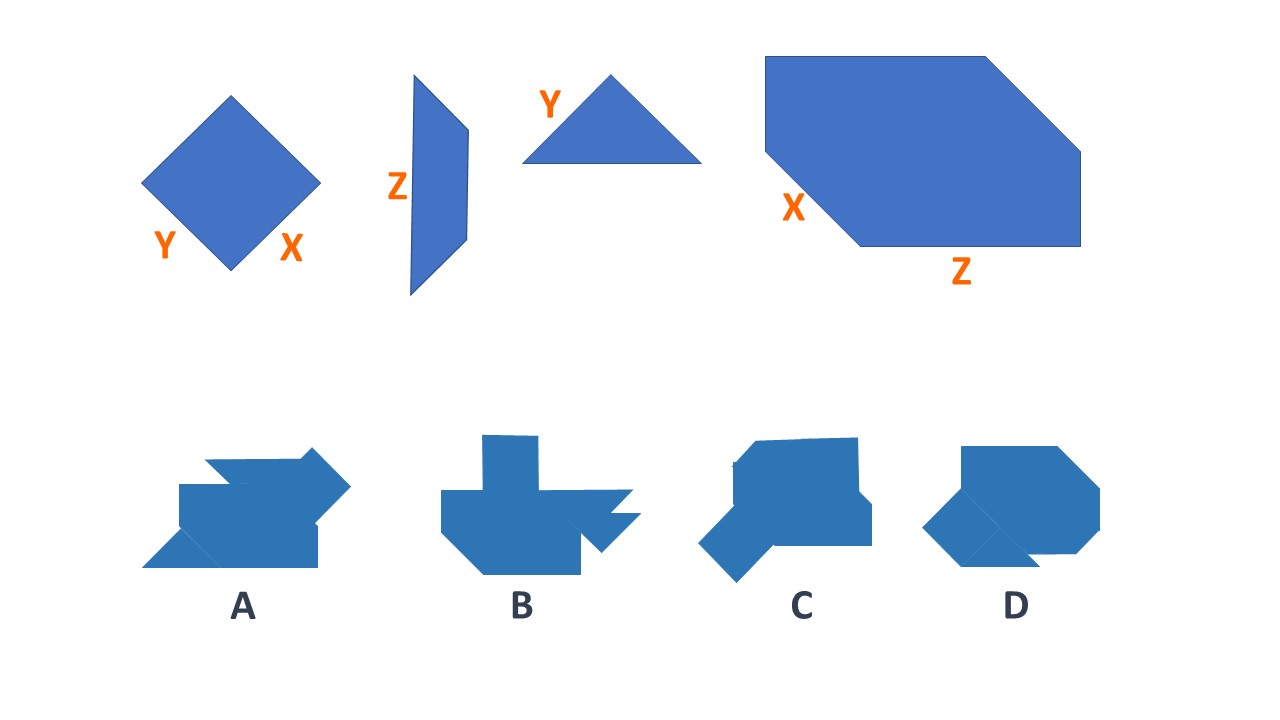
Spatial awareness questions are often used in pre-employment screening assessments for technical roles, and they tend to relate to the manipulation of space and shapes in both 2D and 3D.
Example Spatial Awareness Question
Mechanical Reasoning
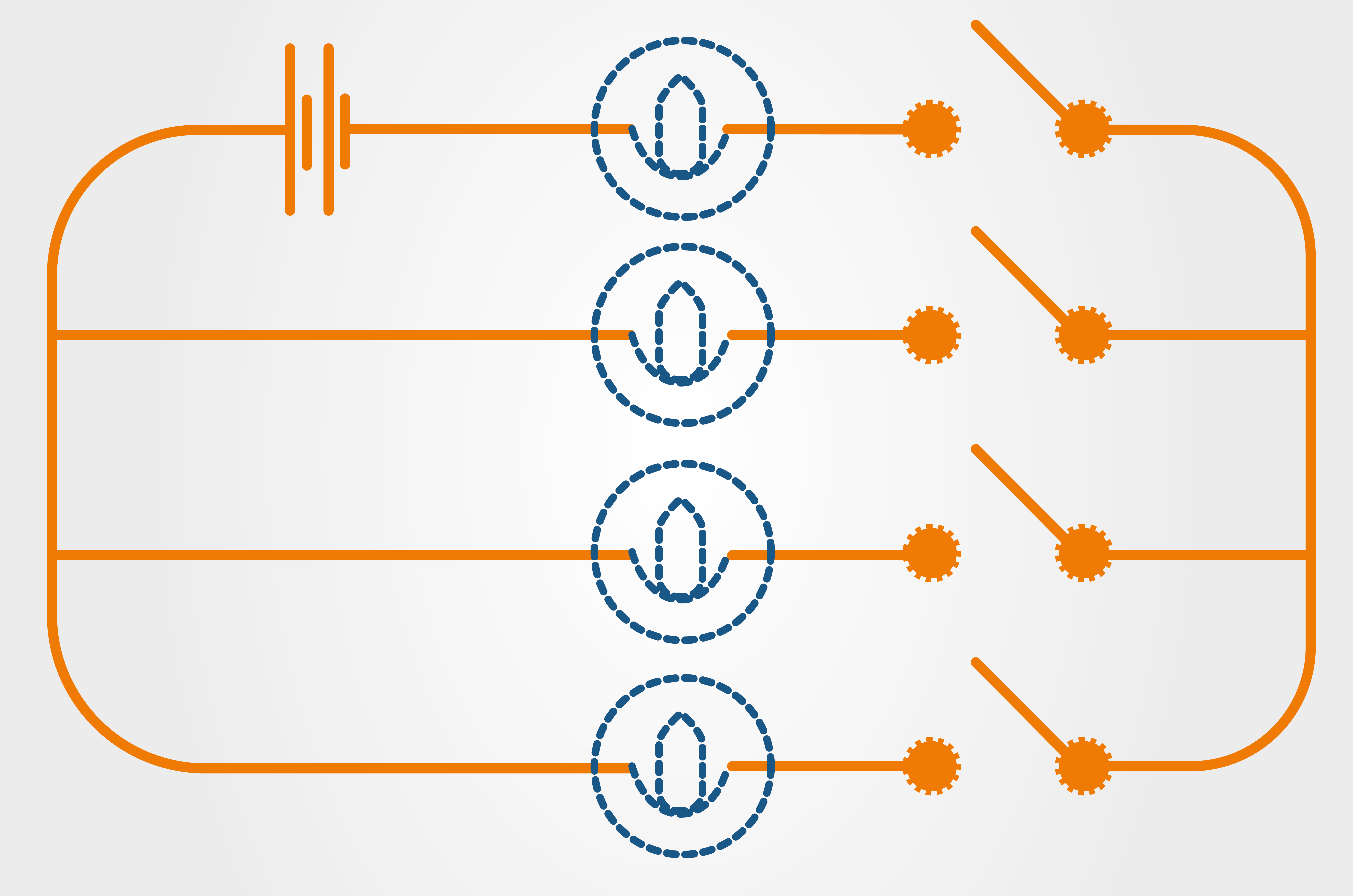
Mechanical tests allow candidates to demonstrate their knowledge and the application of mechanical concepts and physics like pulleys and gravity, levers and electrical circuits.
These are usually only used in assessments for positions that require some mechanical knowledge, like an engineering position.
Try a Mechanical Reasoning Test
How Are Cognitive Tests Administered?
Most cognitive ability tests are administered online and are sent to candidates to be completed at home in their own time. In some cases, you may be required to complete them at an assessment center, or before or after a face-to-face interview at the company.
Cognitive ability tests are usually produced by a test publisher, and although the business may have a bespoke package of pre-employment assessments, it is usually the third-party publisher that administers the tests, collates the results and feeds back to the employer.
This means there is a range of cognitive ability tests that you might take.
Although they share similarities, they will also have notable differences. If you can find out your test publisher, you can familiarize yourself with the structure, time limit and format of the assessment to make your practice sessions more effective.
How to Prepare for a Cognitive Ability Test in 2026
Although no previous knowledge is needed for a cognitive ability test, it is still important to practice thoroughly and efficiently.
With the often-heavy time pressure in these assessments, familiarity will help you perform well, as will finding the most efficient way to deal with the questions.
Step 1. Practice
If you can find out the publisher of the test you will be taking, then you can find online practice papers that are the same format, type of questions and timings of the real thing.
Prep packs such as those at JobTestPrep simulate the test that you will take, offering multiple practice papers as well as strategies to help you pass.
Of course, if you cannot find out the publisher through contacting the recruiter or by an online search, then practice papers will help. You can find free online papers and tests for all types of questions, which is especially useful if you know that you have a specific weakness that needs extra work.
Step 2. Familiarity Is Important
The more familiar you become with the structure, format and timings of the test, the less apprehensive you will feel in the real assessment.
It will help you to know how the questions should be answered and how fast you need to move on from each one.
Step 3. Practice Under Test Conditions
A recognized pressure in cognitive ability tests is the timing. For almost all test publishers, time constraints mean that you will not have much time to answer each question and you want to make sure that you give yourself the opportunity to answer as many as possible.
If your practice tests are not timed, it might be a good idea to use a stopwatch.
Take the number of questions and work out how much time you can spend on each during your practice – you will probably find that you have much less time than you originally thought.
Make sure that your practice time is spent somewhere quiet where you will not be disturbed. Practice should mimic what the actual test will be like as much as possible to be effective.
Step 4. Work on Your Weaknesses
As the cognitive ability tests will move from one subject to another throughout the test, you are likely to come across more than one question that will test you on areas where you might not be as strong.
You can (in some assessments) skip questions and come back to them later. However, with the time constraint, it is a safer bet to answer every question to the best of your ability as you go along.
If, during your practice, you realize there are questions that you do need to become faster or stronger on, try and focus your practice on them.
Find solving strategies that allow you to work out the answers quickly, like elimination or targeted reading.
Step 5. Read Every Question Carefully
Although you might find that the question seems obvious, wasting the opportunity for a correct answer by rushing is never a good idea.
Make sure you read the question carefully so that you understand what it is asking before you try and answer. Don’t allow the time pressure to rush you when you need to consider details.
Step 6. Don't Apply Outside Knowledge
All the information you need to answer correctly is provided in the question, and that means you need to take what you are presented with as the truth – even if you know differently.
Basic knowledge of language and vocabulary, math and mechanical principles (if necessary) will be enough to give you the tools to answer cognitive ability questions.
How to Improve Cognitive Ability in 2026
There are some steps that you can take to improve your cognitive ability in day-to-day life outside of practicing for a test.
Some of them are simple, basic changes to your outlook and routine that can really make a difference.
Health and Wellbeing
Your body is a biomechanical machine, and as such, it needs the right fuel to perform well. This means that, for best results, focus on what you are putting into your body.
Eat well (and regularly), focusing on oily fish and leafy green vegetables, and make sure you stay hydrated.
Sleep is so important to cognitive ability. It helps to give you energy and improve your memory.
Minimize stress, as cortisol produced by stressful situations can actually impair brain function.
Don’t forget to exercise. Aerobic exercise is great for improving oxygen circulation around the body and to the brain – great for a healthy mind. The endorphins from an exercise session can also help battle stress and aid sleep.
Cultivate a Growth Mindset
Getting into a development phase can be difficult but cultivating a growth mindset can help you believe that you can achieve anything.
Your brain is always developing – that is not something that stops in childhood – so get out of your comfort zone and learn something new. This could be a new language, for example, or a new hobby like playing a musical instrument.
Practice Brain Exercises
Brain exercises don’t need fancy equipment or a gym. You can practice working more with your brain by completing crosswords and sudoku puzzles or playing strategy-based board games.
Reading books will expand your vocabulary and help you think critically about passages of text, and if you need to grow your logic skills, then chess is a great game to play.
Think outside the box and play strategy video games, or write a novel, poetry or song lyrics.
Develop Your Ability to Focus
Focus is a skill that is really important and often overlooked – but if you can hone your focus on the task at hand, you will find that you can work through cognitive ability tests quickly and efficiently without distractions.
However you choose to focus, such as by wearing headphones to shut out extraneous noise, keep practicing. Try and use more senses to increase your understanding – read aloud, make notes or listen to audio clips.
Final Thoughts
Cognitive ability tests are quick and simple pre-employment assessment tools. They can be used to cut down a potential hiring pool in a way that removes unconscious bias and offers an objective snapshot of the general intelligence of the candidate.
Although tests vary according to publisher and industry, they all cover a number of subjects in a short space of time, needing fast reactions and quick calculations to be successful.
Although they do not need any specific knowledge, it is always a good idea to thoroughly practice before a cognitive ability test so that you are familiar with the layout and to ensure that you have efficient strategies for answering questions.
Cognitive ability tests are not the only way a candidate’s suitability for a role is assessed, but good performance in them will help to show you are a good fit.