
How to Pass Personality Tests for Jobs (2026 Guide)
Updated October 14, 2025


- What Are Personality Tests?
- What are the Different Types of Personality Traits?
empty
empty
empty
empty
empty
empty
empty
empty
empty
empty
empty
empty
- Desirable and Undesirable Personality Traits
empty
empty
empty
empty
empty
empty
- What Are The Personality Tests Used For Hiring in 2026?
empty
empty
empty
- For What Reasons Are Personality Tests Used In Jobs Today?
empty
empty
empty
- How Do Personality Tests Work?
- How To Measure Personality Tests
- How Should a Manager Use Personality Tests?
- How to Pass Personality Tests – Top Tips (2026)
empty
- Frequently Asked Questions
- Summary
What Are Personality Tests?
Personality tests determine personality or character traits. These personality assessments are usually given online during the job application process.
There are several formats used for these personality tests for jobs but the most common is a questionnaire.
Personality has a significant role to play in deciding whether you have the enthusiasm and motivation that the employer is looking for. It also determines how well you are going to fit into an organization, in terms of your personality, attitude and general work style.
In most working situations, it’s the personalities of the people involved that affect the day-to-day success of the organization.
If a manager can’t motivate their staff or the team doesn't work well together, then the quality of service and productivity will suffer.
Personality testing is a huge industry that has expanded greatly in the last decade.
There are currently well over 2,500 personality questionnaires on the market and each year dozens of new companies appear with new products.
Some of these products are broad-spectrum tests designed to classify basic personality types, some are designed to test candidates for suitability for a particular job and some are designed to test for particular traits – for example, honesty and integrity.
A downside to personality testing is that people are not always accurate when identifying their own personality traits and can sometimes choose answers to make themselves appear more likable.
What are the Different Types of Personality Traits?
Psychologists define personality as:
‘The particular pattern of behavior and thinking that prevails across time and contexts, and differentiates one person from another.’
A personality trait is assumed to be some enduring characteristic that is relatively constant as opposed to the present temperament of that person which is not necessarily a stable characteristic.
Consequently, trait theories are specifically focused on explaining the more permanent personality characteristics that differentiate one individual from another.
For example, being:
- Dependable
- Trustworthy
- Friendly
- Cheerful, etc.
The goal of psychologists is to understand the causes of individual differences in behavior. To do this, one must firstly identify personality traits and then determine the variables that produce and control them.
One of the first trait theories was developed in ancient Greece by the physician Galen who suggested that our personality was a reflection of the four humors (fluids) that were important in the human body.

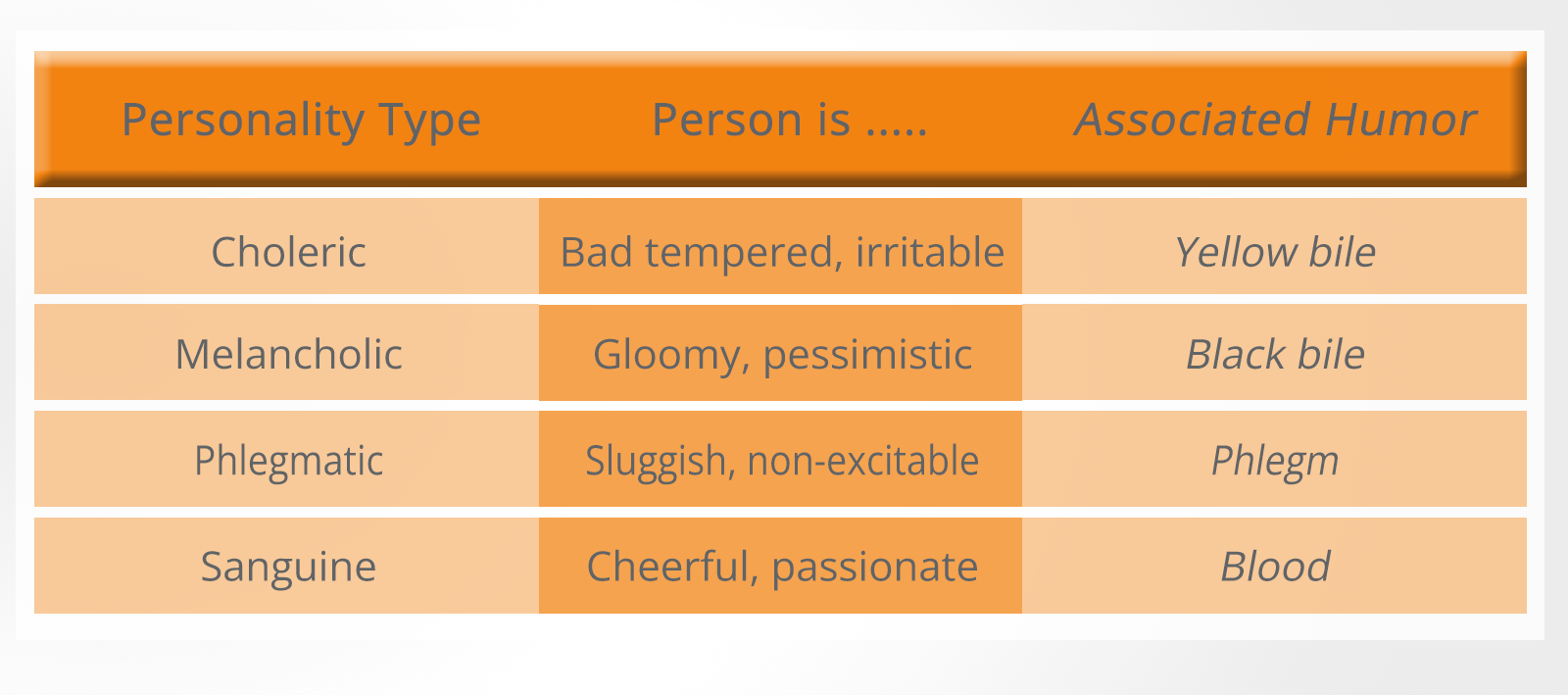
If one of these humors dominated the others then the personality type associated with that humor would be observed.
The kind of strict categorization suggested by theories like Galen’s suggests that there very different types of personalities.
More recently, personality theories have leaned more towards the idea that we all have similar personality traits or characteristics, but the extent to which we possess that trait differs.
For example, we often classify people as tall or short, but we don’t really think that people must be either one or the other. We understand that height is a trait the some of us have more of than others, but we all have it to some extent.
If we accept the existence of common personality traits that we all have to varying extents, then the next stage is to agree on how to define them.
Personality Traits Test: Factor Analysis
Psychologists have used a technique known as factor analysis in the personality tests to identify groups of items that are strongly inter-correlated (these groups of items are known as factors) and believe that these factors provide operational definitions of personality traits.
These traits are validated by correlations between scores on these factors and observed behavior.
For example, a factor emphasizing extraversion would be correlated with outgoing behavior.
Personality Trait Test : The Big Five Personality Traits Model
Modern personality theory is a relatively new field and really began in the 1920s.
For more on the history of personality theories, see our dedicated article.
Costa & McCrae’s 'five trait' model has received significant support from other research and is now widely accepted among psychologists.

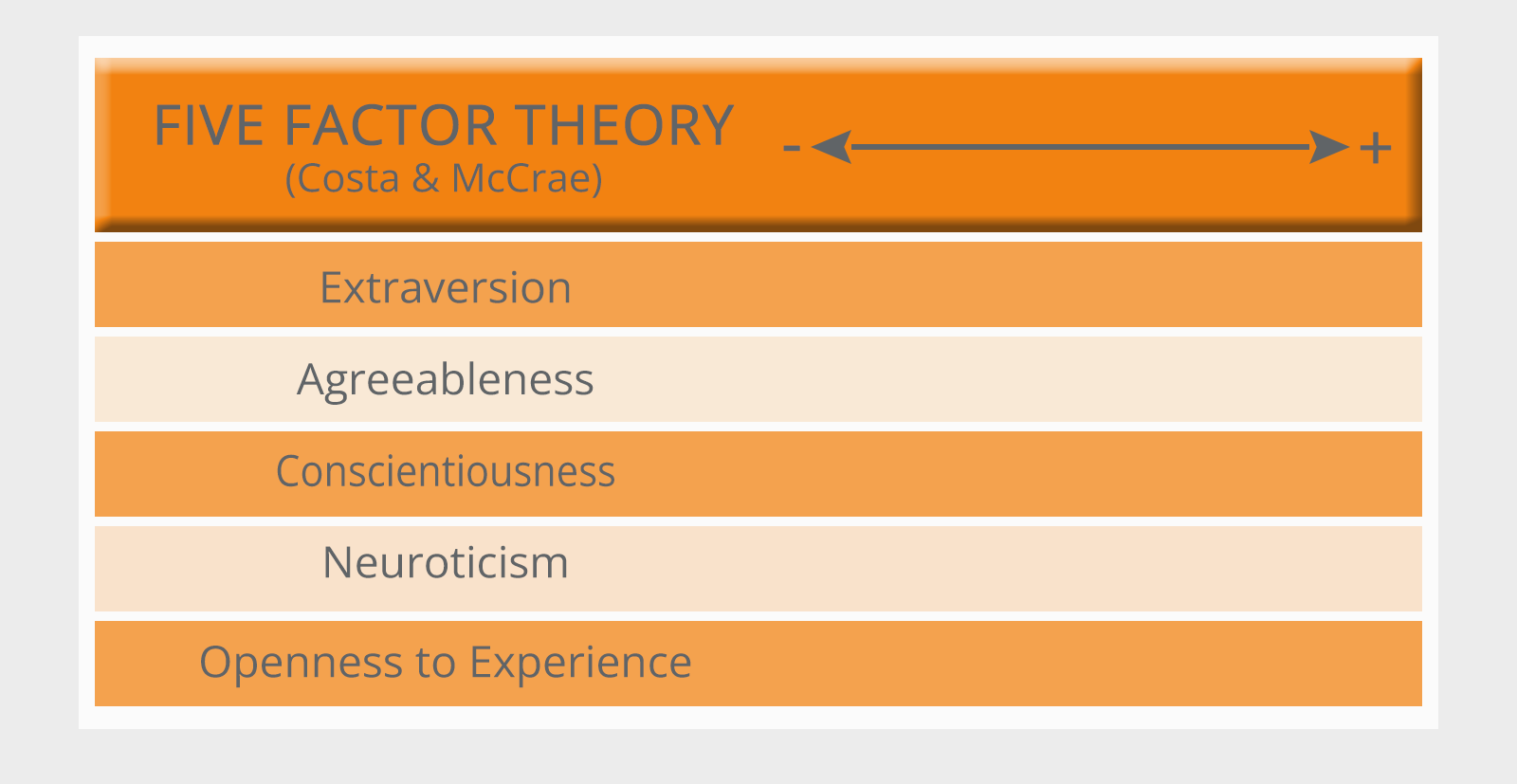
Each of these five personality traits describes, relative to other people, the frequency or intensity of a person's feelings, thoughts or behaviors.
Everyone possesses all five of these traits to a greater or lesser degree. They exist on a continuum rather than as attributes that a person does or does not have.
These five traits/factors are:
1. Extraversion Personality Trait – How ‘energetic’ one is
Extraversion is marked by pronounced engagement with the external world. Extraverts enjoy being with people, are full of energy and often experience positive emotions.
They tend to be enthusiastic, action-oriented, individuals who are likely to say yes to opportunities for excitement.
In groups, they like to talk, assert themselves and draw attention to themselves.
Introverts lack the exuberance, energy and activity levels of extraverts. They tend to be quiet, low-key, deliberate and disengaged from the social world.
Their lack of social involvement should not be interpreted as shyness or depression; the introvert simply needs less stimulation than an extravert and prefers to be alone.
The independence and reserve of the introvert is sometimes mistaken as unfriendliness or arrogance. In reality, an introvert who scores high on the agreeableness dimension will not seek others out but will be quite pleasant when approached.
2. Agreeableness Personality Trait – One’s level of orientation towards other people
Agreeableness reflects individual differences in concern with cooperation and social harmony.
Agreeable individuals value getting along with others. They are therefore considerate, friendly, generous, helpful and willing to compromise their interests with others.
Agreeable people also have an optimistic view of human nature. They believe people are basically honest, decent and trustworthy.
Disagreeable individuals place self-interest above getting along with others.
They are generally unconcerned with others' well-being and therefore are unlikely to extend themselves for other people. Sometimes their skepticism about others' motives causes them to be suspicious, unfriendly and uncooperative.
Agreeableness is obviously advantageous for attaining and maintaining popularity. Agreeable people are better liked than disagreeable people. On the other hand, agreeableness is not useful in situations that require tough or absolute objective decisions. Disagreeable people can make excellent scientists, critics or soldiers.
3. Conscientiousness Personality Trait – How ‘structured’ one is
Conscientiousness concerns how we control, regulate and direct our impulses.
Impulses are not inherently bad; occasionally time constraints require a snap decision, and acting on our first impulse can be an effective response.
Also, in times of play rather than work, acting spontaneously and impulsively can be fun.
Nonetheless, acting on impulse can lead to trouble in several ways. Some impulses are antisocial.
Uncontrolled antisocial acts not only harm other members of society but also can result in retribution toward the perpetrator.
Another problem with impulsive acts is that they often produce immediate rewards but also undesirable, long-term consequences.
Impulsive behavior, even when not seriously destructive, diminishes a person's effectiveness in significant ways:
- Acting impulsively disallows contemplating alternative courses of action, some of which would have been wiser than the impulsive choice.
- Impulsivity also sidetracks people during projects that require organized sequences of steps or stages.
Accomplishments of an impulsive person are therefore small, scattered and inconsistent.
A hallmark of intelligence, what potentially separates human beings from earlier life forms, is the ability to think about future consequences before acting on an impulse. Persons who score high on the conscientiousness scale are perceived by others as intelligent.
Practice Personality Test with JobTestPrep
4. Neuroticism Personality Trait – Tendency to worry
Freud originally used the term ‘neurosis’ to describe a condition marked by mental distress, emotional suffering and an inability to cope effectively with the normal demands of life.
He suggested that everyone shows some signs of neurosis, but that we differ in our degree of suffering and our specific symptoms of distress.
Today, neuroticism refers to the tendency to experience negative feelings.
Those who score high on neuroticism may experience primarily one specific negative feeling such as anxiety, anger or depression, but are likely to experience several of these emotions.
People high in neuroticism are emotionally reactive. They respond emotionally to events that would not affect most people and their reactions tend to be more intense than normal.
They are more likely to interpret ordinary situations as threatening, and minor frustrations as hopelessly difficult. Their negative emotional reactions tend to persist for unusually long periods, which means they are often in a bad mood.
These problems in emotional regulation can diminish a neurotic's ability to think clearly, make decisions and cope effectively with stress.
At the other end of the scale, individuals who score low in neuroticism are less easily upset and are less emotionally reactive. They tend to be calm, emotionally stable and free from persistent negative feelings.
Freedom from negative feelings does not mean that low scorers experience a lot of positive feelings; the frequency of positive emotions is a component of the extraversion domain.
5. Openness to Experience Personality Trait – Tendency to be speculative and imaginative
‘Openness to experience’ describes a dimension of cognitive style that distinguishes imaginative, creative people from down-to-earth, conventional people. Open people are intellectually curious, appreciative of art and sensitive to beauty.
They tend to be, compared to closed people, more aware of their feelings. They tend to think and act in individualistic and nonconforming ways.
Intellectuals typically score high on openness to experience.
Another characteristic of the ‘open’ cognitive style is a facility for thinking in symbols and abstractions far removed from concrete experience.
Depending on the individual's specific intellectual abilities, this symbolic cognition may take the form of mathematical, logical or geometric thinking, artistic and metaphorical use of language, music composition or performance, or one of the many visual or performing arts.
People with low scores on openness to experience tend to have narrow, common interests. They prefer the plain, straightforward and obvious over the complex, ambiguous and subtle.
They may regard the arts and sciences with suspicion, regarding these endeavors as abstruse or of no practical use. Closed people prefer familiarity over novelty; they are conservative and resistant to change.
Openness is often presented as healthier or more mature by psychologists, who are often themselves open to experience. However, open and closed styles of thinking are useful in different environments.
The intellectual style of the open person may serve a professor well, but research has shown that closed thinking is related to superior job performance in police work, sales and many service occupations.
Remember, none of the five traits is in themselves positive or negative; they are simply characteristics that individuals exhibit to a greater or lesser extent.

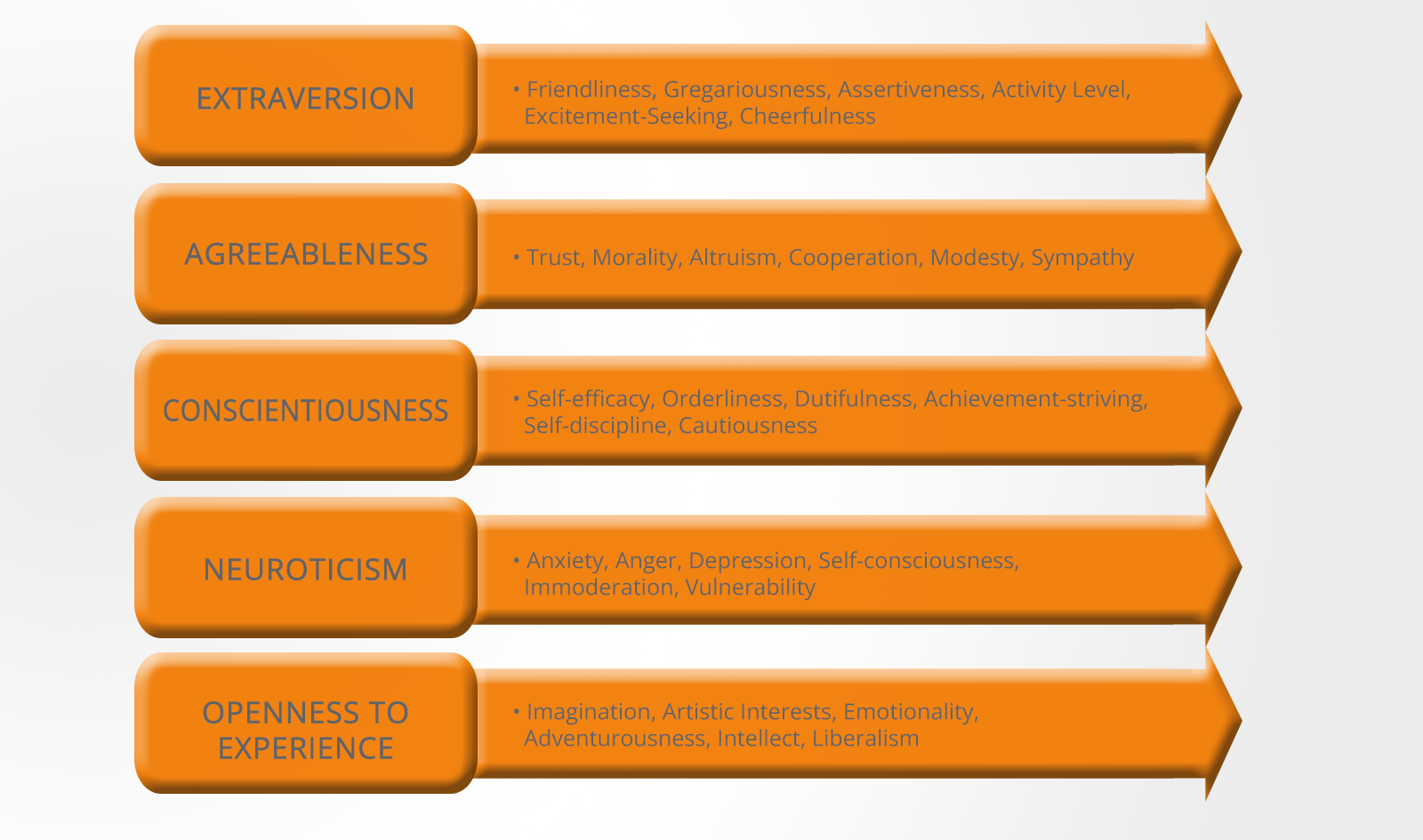
Each of the big five personality traits is made up of six facets or sub-traits. These can be assessed independently of the trait that they belong to.
The 6 Facets of Extraversion
-
Friendliness. Friendly people genuinely like other people, make friends quickly and openly demonstrate positive feelings toward others. Low scorers in friendliness are not necessarily cold and hostile, but they do not reach out to others and are perceived as distant and reserved.
-
Gregariousness. Gregarious people find the company of others pleasantly stimulating and rewarding. Low scorers do not necessarily dislike being with people sometimes, but their need for privacy and time to themselves is much greater than for individuals who score high on this scale.
-
Assertiveness. High scorers in assertiveness like to speak out, take charge and direct the activities of others. They tend to be leaders in groups. Low scorers tend not to talk much and let others control the activities of groups.
-
Activity level. Active individuals lead fast-paced, busy lives. People who score low on this scale follow a slower and more leisurely pace.
-
Excitement-seeking. High scorers on this scale are easily bored without high levels of stimulation. They are likely to take risks and seek thrills. Low scorers are overwhelmed by noise and commotion and are adverse to thrill-seeking.
-
Cheerfulness. This scale measures positive mood and feelings, not negative emotions (which are a part of the neuroticism domain). Persons who score high on this scale typically experience a range of positive feelings, including happiness, enthusiasm, optimism and joy. Low scorers are not as prone to such energetic, high spirits.
The 6 Facets of Agreeableness
-
Trust. A person with high trust assumes that most people are fair, honest and have good intentions. Persons low in trust may see others as selfish, devious and potentially dangerous.
-
Morality. High scorers on this scale see no need for pretense or manipulation when dealing with others and are therefore candid, frank and sincere. Low scorers believe that a certain amount of deception in social relationships is necessary. Low scorers are not unprincipled or immoral; they are simply more guarded.
-
Altruism. Altruistic people find helping other people genuinely rewarding. Doing things for others is a form of self-fulfillment rather than self-sacrifice. Low scorers on this scale do not particularly like helping those in need. Requests for help feel like an imposition rather than an opportunity for self-fulfillment.
-
Cooperation. Individuals who score high on this scale dislike confrontations. They are willing to compromise or deny their own needs to get along with others. Those who score low on this scale are more likely to intimidate others to get their way.
-
Modesty. High scorers on this scale do not like to claim that they are better than other people. In some cases, this attitude may derive from low self-confidence or self-esteem. Those who are willing to describe themselves as superior tend to be seen as disagreeably arrogant by other people.
-
Sympathy. People who score high on this scale are tender-hearted and compassionate. They feel the pain of others vicariously and are easily moved to pity. Low scorers are not affected strongly by human suffering. They pride themselves on making objective judgments based on reason. They are more concerned with truth and impartial justice than with mercy.
The 6 Facets of Conscientiousness Facets
-
Self-efficacy. Self-efficacy describes confidence in one's ability to accomplish things. High scorers believe they have the intelligence (common sense), drive and self-control necessary for achieving success. Low scorers do not feel effective and may have a sense that they are not in control of their lives.
-
Orderliness. Persons with high scores on orderliness are well-organized. They like to live according to routines and schedules. Low scorers tend to be disorganized and scattered.
-
Dutifulness. This scale reflects the strength of a person's sense of duty and obligation. Those who score high on this scale have a strong sense of moral obligation. Low scorers find contracts, rules and regulations overly confining. They are likely to be seen as unreliable or even irresponsible.
-
Achievement-striving. Individuals who score high on this scale strive hard to achieve excellence. They often have a strong sense of direction in life, but extremely high scorers may be too single-minded and obsessed with their work. Low scorers are content to get by with a minimal amount of work and might be seen by others as lazy.
-
Self-discipline. People who possess high self-discipline can overcome reluctance and stay on track despite distractions. Those with low self-discipline procrastinate and show poor follow-through, often failing to complete tasks – even tasks they want very much to complete.
-
Cautiousness. Cautiousness describes the disposition to think through possibilities before acting. High scorers take their time when making decisions. Low scorers often say or do the first thing that comes to mind without deliberating alternatives and probable consequences.
The 6 Facets of Neuroticism Facets
-
Anxiety. The ‘fight-or-flight’ system of the brain of anxious individuals is too easily and too often engaged. Therefore, people who are high in anxiety often feel like something dangerous is about to happen. Persons low in anxiety are generally calm and fearless.
-
Anger. High scorers feel enraged when things do not go their way. They are sensitive about being treated fairly and feel resentful and bitter when they feel they are being cheated. Low scorers do not get angry often or easily.
-
Depression. This scale measures the tendency to feel sad, dejected and discouraged. High scorers lack energy and have difficulty initiating activities. Low scorers tend to be free from these depressive feelings.
-
Self-consciousness. Self-conscious individuals are sensitive about what others think of them. Their concern about rejection and ridicule causes them to feel shy and uncomfortable abound others. Low scorers, in contrast, do not suffer from the mistaken impression that everyone is watching and judging them. They do not feel nervous in social situations.
-
Immoderation. Immoderate individuals feel strong cravings and urges that they have difficulty resisting. They tend to be oriented toward short-term pleasures and rewards rather than long-term consequences. Low scorers do not experience strong, irresistible cravings and consequently do not find themselves tempted to overindulge.
-
Vulnerability. High scorers experience panic, confusion and helplessness when under pressure or stress. Low scorers feel more poised, confident and clear-thinking when stressed.
The 6 Facets of Openness Facets
-
Imagination. To imaginative individuals, the real world is often too plain and ordinary. High scorers on this scale use fantasy as a way of creating a richer, more interesting world. Low scorers are on this scale are more oriented to facts than fantasy.
-
Artistic interests. High scorers on this scale love beauty, both in art and in nature. They become easily involved and absorbed in artistic and natural events. Low scorers lack aesthetic sensitivity and interest in the arts.
-
Emotionality. High scorers have good access to and awareness of their own feelings. Low scorers are less aware of their feelings and tend not to express their emotions openly.
-
Adventurousness. High scorers on adventurousness are eager to try new activities, travel to foreign lands and experience different things. They find familiarity and routine boring and will take a new route home just because it is different. Low scorers tend to feel uncomfortable with change and prefer familiar routines.
-
Intellect. Intellect and artistic interests are the two most important, central aspects of openness to experience. High scorers are open-minded to new and unusual ideas and like to debate intellectual issues. Low scorers prefer dealing with people or things rather than ideas. They regard intellectual exercises as a waste of time. Intellect should not necessarily be equated with intelligence; although high scorers score slightly higher than low-Intellect individuals on standardized intelligence tests.
-
Liberalism. Psychological liberalism refers to a readiness to challenge authority, convention and traditional values. Psychological conservatives prefer the security and stability brought by conformity to tradition. Psychological liberalism and conservatism are not identical to political affiliation, but certainly incline individuals toward certain political parties.
It is possible, although unusual, to score high in one or more facets of a personality trait and low in other facets of the same trait. For example, you could score highly in imagination, artistic interests, emotionality and adventurousness, but score low in intellect and liberalism.
Desirable and Undesirable Personality Traits
All employers see some personal qualities as desirable.
For example:


If a potential employee seems to be missing any one of the personal qualities listed above then they will almost certainly be screened out by the personality test.
This is true even if the job they are applying for does not explicitly require the personal quality in question.
Conversely, all employers see some personal qualities as undesirable.
For example:

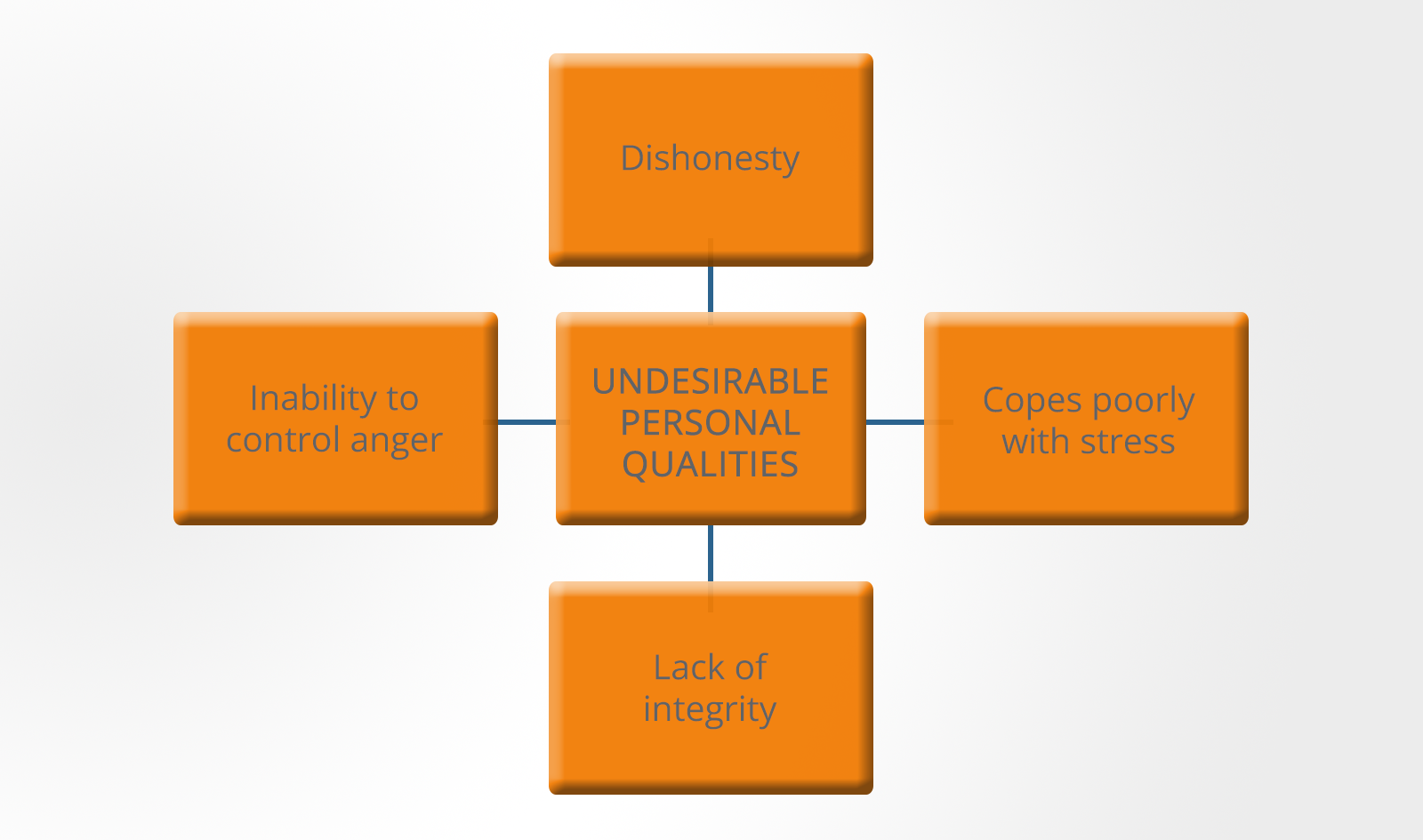
It would be difficult to find an employer who would offer a job to anyone who appeared to have any of the undesirable personal qualities.
Any doubts about your honesty or any hint of a tendency towards angry or violent behavior will put you out of the running immediately.
However, even if you are scrupulously honest and not prone to anger, the way that some questions are interpreted can cause doubts to be raised about both your honesty and your stability.
If you need to prepare for a number of different employment tests and want to outsmart the competition, choose a Premium Membership from JobTestPrep.
You will get access to three PrepPacks of your choice, from a database that covers all the major test providers and employers and tailored profession packs.
Honesty/Integrity
People applying for jobs in retail, banking or the security services industries are often asked to take an integrity test which claims to predict if they will lie, cheat or steal on the job.
These questions appear more frequently in personality tests in the US than elsewhere.
The important thing is that the job personality tests that use these questions are not interested in mitigating circumstances. They want clear answers and they had better be the right ones.
Whatever you may think privately, you should strongly agree with all of the following types of questions:
- Most people are honest by nature
- Most people can be trusted
- Very few people steal at work
- Teenagers who shoplift should always be punished
- Most people have never shoplifted as teenagers
- Employees who leave work early without permission are stealing
- If someone is undercharged in a shop they should tell the cashier
You should strongly disagree with all of the following types of questions:
- It is human nature to steal from others
- The laws against shoplifting are too harsh
- Most people can not be trusted
- Teenagers often go through a shoplifting stage
You need to be perceived as someone with a rigid sense of right and wrong and with no room for moral ambiguity whatever the circumstances.
You should never admit to even knowing anyone who has engaged in crime of any sort or who has ever used drugs.
Anger
Any hint that you are prone to anger at work will most likely mean the end of your job application.
These types of personality test questions may also refer to vandalism at work, including computer viruses and hacking.
You should strongly agree with all of the following personality quiz questions:
- I have almost never become angry at work
- People who know me would not say I had a temper
- I cannot remember the last time I lost my temper at work
- People who get angry at work should receive counseling
You should strongly disagree with the following types of questions:
- Sometimes my co-workers annoy me
- It’s normal to lose your temper at work occasionally
- When driving, I sometimes get angry with other road users
- Computer hackers are punished too harshly
You need to be perceived as someone who disapproves of anger and anger generated behavior in the workplace.
Stress
You need to show that you cope well with stress and that you have not and suffered any stress-related health problems.
You should agree or strongly agree with all of the following personality test questions types:
- I rarely worry about how well I'm doing at my job
- I never get upset if my work is criticized by my manager
- I have a positive relationship with my co-workers
- I have confidence in my ability to handle my work responsibilities
- I have never suffered physical symptoms due to stress at work
You should disagree or strongly disagree with all of the following types of questions:
- Work is the most stressful thing in my life
- Sometimes I don't feel able to handle all my work responsibilities
- I sometimes worry about losing my job because of office politics
- I have had counseling to help me cope with stress
- I have sometimes lost sleep worrying about work
You need to show that stress has minimal impact on your relationship with others in the workplace, that it does not affect your productivity and that it has never led to any time off work.
Motivation
Employers expect staff to be totally committed to the organization and to getting the job done.
You should agree or strongly agree with personality questions of this type:
- Work is the most important thing in my life
- I admire people who work long hours
- People who know me say I work too hard
- I am nearly always happy to work late or over a weekend if needed
- Employees should be expected to work extra hours to finish a job on time
You should disagree or strongly disagree with personality questions of this type:
- I know many people who work themselves too hard
- Work can be an addiction just like gambling
- I really look forward to my annual vacation
- I feel sorry for people who put in long hours at work
- Vacations are very important to me
You need to be seen as the employee who will go the extra mile every time.
Determination, persistence and the willingness to do whatever it takes to achieve your goals are the things that employers are looking for.
Extraversion
Some jobs have become synonymous with extrovert personalities.
Sales is one example, it is difficult to imagine a successful salesperson who is not naturally extroverted.
However, for almost all jobs, not just sales, employers prefer extroverts over introverts every time.
The reasons for this are twofold:
-
Even people in highly technical jobs work in teams for much of the time, they need to get on with people and get them to cooperate to get the job done.
-
Most employers take a long term view of the people they employ. The person employed today to input figures into spreadsheets could be working as a supervisor or manager in a couple of years and it is better if they appear to have some of the attributes that will be needed in the future.
Obviously, there is no point in trying to pretend that you are highly extroverted if you are not. Psychologists believe extroversion/introversion to be the most difficult personality trait to consciously change. However, you most definitely do not want to appear to be too introverted.
You should strongly agree with all of the following types of personality questions:
- I almost never feel bored at parties
- I am usually described as an outgoing person
- It's easy for people to see my moods
- Almost none of my friends are quiet and reserved
- I find it easy to keep a conversation going
- In social settings, I enjoy introducing myself to an unfamiliar person
You should strongly disagree with all of the following types of personality questions:
- I am usually quiet and reserved at social gatherings
- In conversations, I like to let the other person do most of the talking
- I do not enjoy chatting with strangers
- I find it more productive to work alone than as part of the group
- I avoid being the center of attention whenever possible
- I sometimes try to avoid meeting new people
Leadership
Leadership qualities in professionals at all levels of management play a key role in business success and there has been an increasing interest in the qualities that make someone a leader rather than just a boss.
Many of the graduate and management personality tests try to determine your leadership qualities.
Whatever type of job you are applying for, showing some of these qualities is probably a good thing.
Once again, there is no point in trying to pretend that you are a natural leader if you are not, but you don't want to give the impression that any sort of leadership is beyond you.
You should strongly agree with the following types of personality test questions:
- I have a strong set of personal goals
- Every person has the potential to be creative at work
- People can become more successful through the right motivation
- The great figures in history always looked at least five or 10 years into the future
- Many managers focus too much on details and not the big picture
You should strongly disagree with the following types of personality test questions:
- I rarely have a strong set of personal goals
- The majority of people are already inspired to do their best work
- Nothing motivates employees more than money or fear of losing their job
What Are The Personality Tests Used For Hiring in 2026?
There are many types of personality tests available. Here are some of the most popular personality tests for jobs that you might come across during your job hunt:
1. The Myers-Briggs Type Indicator (MBTI)
One of the most popular personality tests in the world is the Myers-Briggs Type Indicator (MBTI), a psychological-assessment system based on the work of psychologist Carl Jung. Two and a half million Americans a year take the Myers-Briggs test.
The Myers-Briggs assessment is designed to measure preferences in how people see the world and make decisions.
The MBTI test classifies people into types based on four bi-polar dimensions:

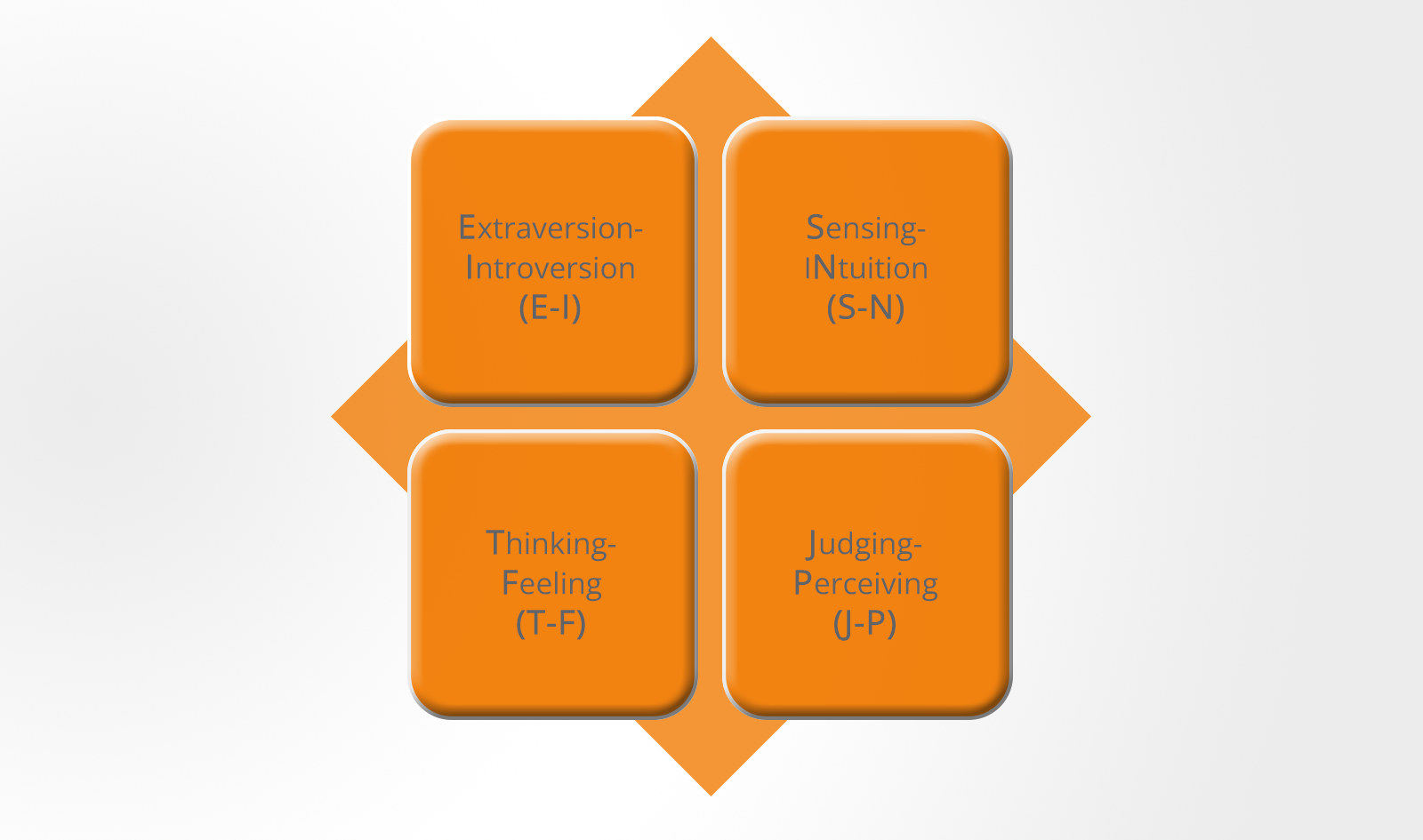
- Extraversion-Introversion (E–I)
- Sensing-INtuition (S–N)
- Thinking-Feeling (T–F)
- Judging-Perceiving (J–P)
The sixteen personality types resulting from the cross-products of these four dimensions are illustrated below:

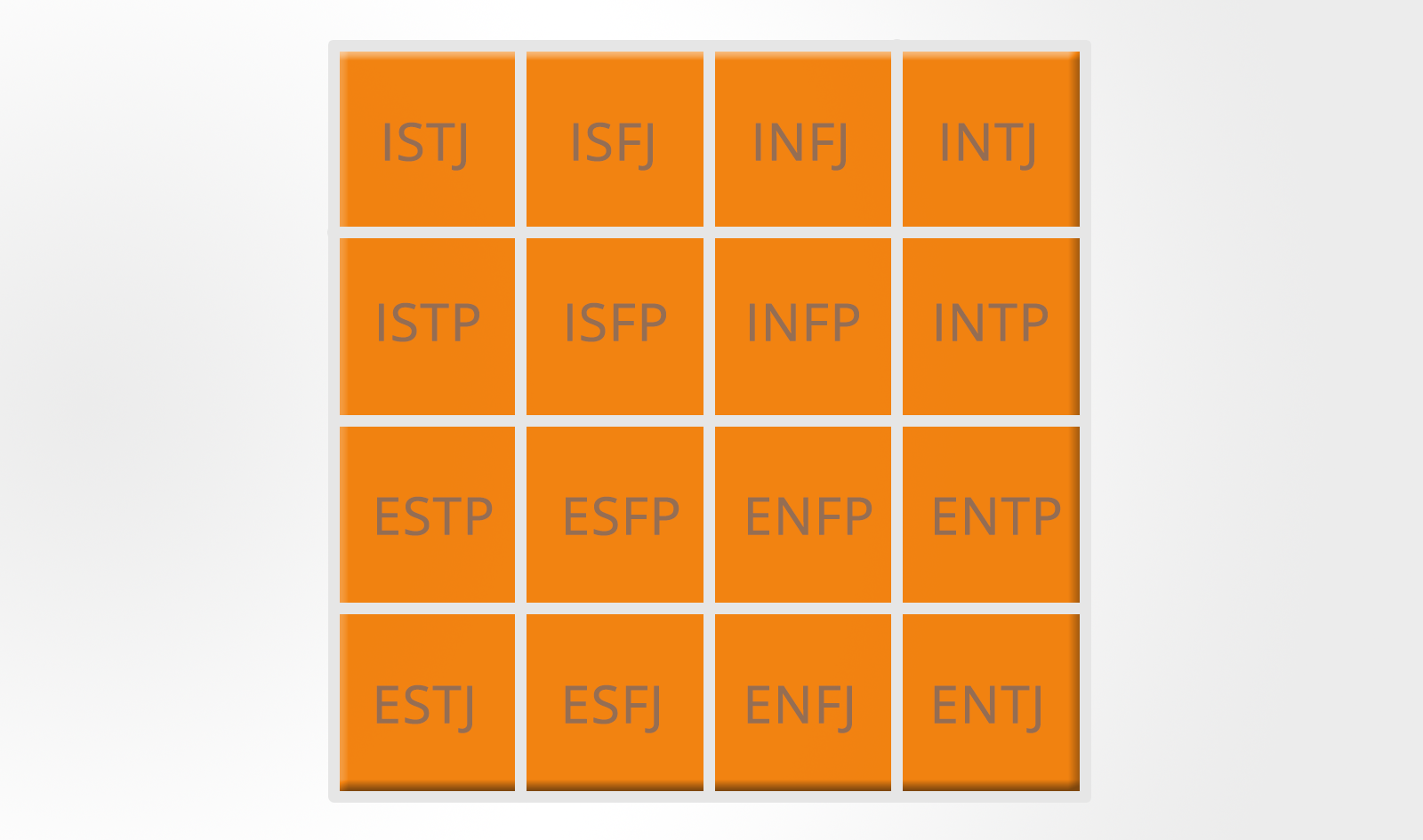
For more information on the Myers-Briggs test, see our dedicated article.
2. SHL Personality Test
The SHL test measures aspects of behavior that are crucial to performance potential which cannot easily be identified by other techniques, such as reading CVs and interviewing.
The SHL OPQ provides a clear, simple framework for understanding the impact of personality on job performance.
The SHL OPQ is available in more than 30 languages and is administered online.
The questionnaire takes the majority of people less than 30 minutes to complete and a range of reports are available, providing clear, concise, graphical summaries of performance against job competencies.
Most of these reports are designed for use by line managers.
Popular reports include:
- The Manager Plus Report
- The Candidate Plus Report
- The Universal Competency Report
- The Sales Report
- The Team Development Report
- The Leadership Report
3. DISC Test
DISC is a behavioral model based on the work of William Marston PhD.
It focuses on styles and preferences of behavior which are classified by testing a person's preferences in word associations.
DISC is an acronym for:
- Dominance – Relating to control, power and assertiveness
- Influence – Relating to social situations and communication
- Steadiness – Relating to patience, persistence and thoughtfulness
- Conscientiousness – Relating to structure and organization
For more on the DISC test, see our dedicated article.
For What Reasons Are Personality Tests Used In Jobs Today?
Personality tests for jobs are a great way for employers to pre-screen potential candidates for an interview and also to help rate a candidate before a hiring decision is made.
Many jobs attract hundreds of applicants. An easy way to cut down on time spent pre-screening applicants is to give a personality test.
You can also use personality assessment to help choose specific candidates that will enhance your current team by choosing personality traits that your current employees do not have.

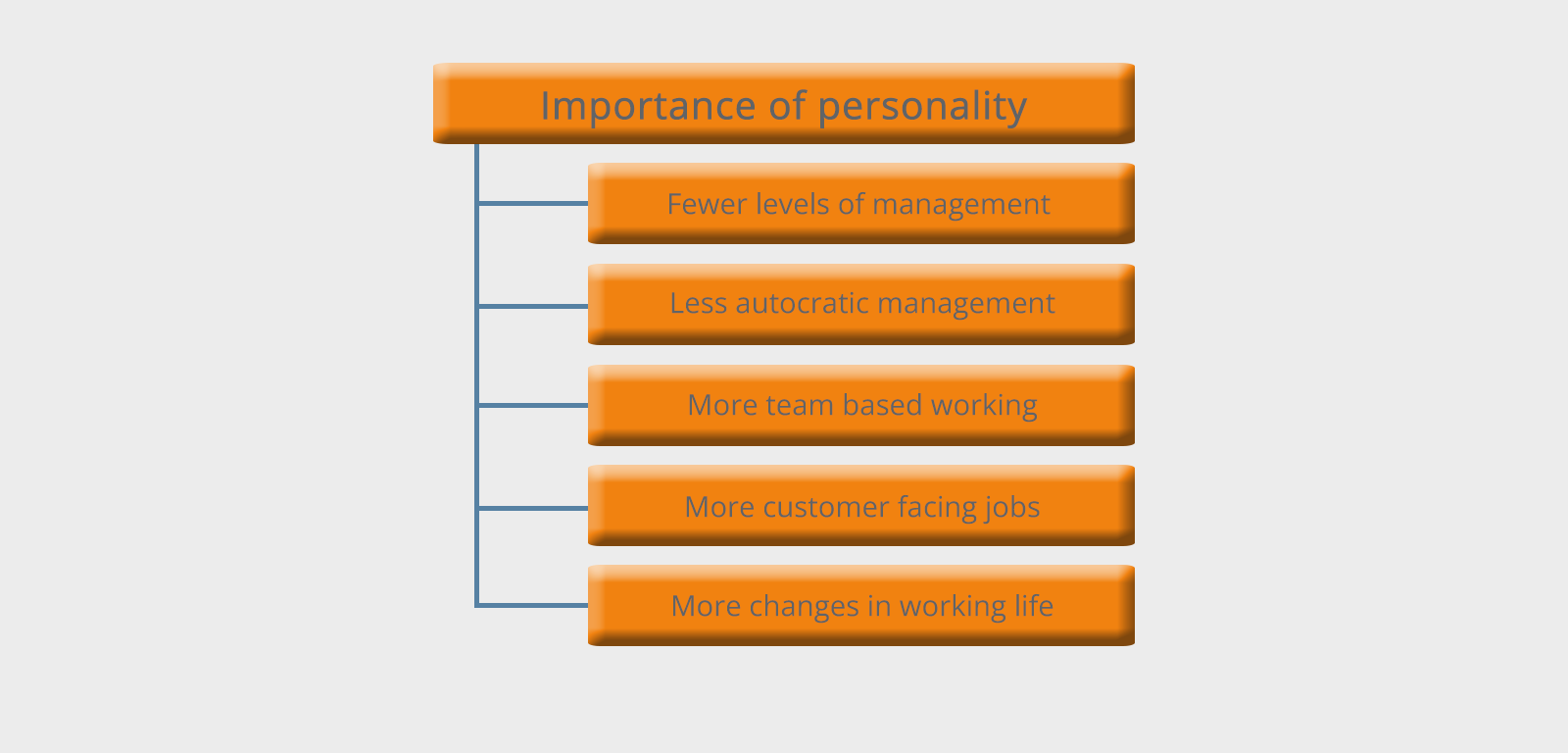
Personality Is Important to Employers
There have been significant changes in the past 20 years in the way that organizations operate. For example, management styles tend to be less autocratic and there are usually fewer levels of management than there were.
The move, in the western world at least, towards more knowledge-based and customer-focused jobs means that individuals have more autonomy even at fairly low levels within organizations.
These factors have contributed to your personality being seen as more important now than it was in the past.
There are only three questions the employer has to answer during the selection process:
- Do you have the right skills and experience?
- Do you have the required enthusiasm and motivation?
- Are you a good culture fit? Are you going to fit in, in terms of your personality, attitude and general work style?
Personality has a significant role to play in providing answers to the second and third of these questions.
Employers Want a Legally Compliant Selection Process
Despite the controversy surrounding some aspects of personality testing, there has been a dramatic increase in the use of personality tests over the past ten years or so.
The single most frequently given reason for increases in testing is the need to have a selection process that can withstand legal challenges.
Increased test use can, therefore, be seen in part as a defensive strategy, adopted in response to regulation and legislation.
Many HR departments are keen to use resources that give a scientific or technical aspect to the HR function. Personality questionnaires do this very well as they are seen to give the notoriously subjective selection process some objective and scientific credibility.
Personality Tests Are Easy to Administer
Another factor is the ease with which these personality assessment tests can now be delivered online.
This approach has distinct advantages over paper and pencil tests:
- There is no need to print and distribute printed material. This has dramatically lowered the cost of test administration.
- Results can be processed immediately with no human input.
- There has been a growing acceptance of personality testing among the general public.
- There are now more suppliers producing a greater variety of tests. This has driven costs down even further and increased the choice of tests available to recruiting organizations.
How Do Personality Tests Work?
The principle behind personality questionnaires is that it is possible to quantify your intrinsic personality characteristics by asking you about your feelings, thoughts and behavior.
You will be presented with statements describing various ways of feeling or acting and will be asked to answer each one on a two-point, five-point or seven-point scale.
For example:
1. I enjoy public speaking
A) True
B) False
2. I have clear personal goals
A) strongly disagree
B) disagree
C) neutral
D) agree
E) strongly agree
3. I am good at dealing with difficult people
A) very strongly disagree
B) strongly disagrees
C) disagree
D) neutral
E) agree
F) strongly agree
G) very strongly agree
The number of questions you are expected to answer varies from about 50 to 200, depending on the duration of the personality test.
It is easy to see that some of the questions could be answered honestly in different ways depending on your particular interpretation of them on the day.
For example, take question 3 above, 'I am good at dealing with difficult people’.
Your answer to this question depends on your interpretation of two things:
- First, 'good', does this mean good compared to other people in your office, good compared to the general public or good compared to some other group?
- Second, 'difficult people', does this mean people who are abusive and violent, people who are withdrawn, people who are selfish or what?
The important point to remember is that even the best of the personality questionnaires used in selection are far from perfect.
However, even if we accept that these personality assessments tests do have some shortcomings, we still need to know what they are trying to measure and why.
How To Measure Personality Tests
The companies that produce personality tests and the human resources staff who use them invariably assessments to these tests as personality ‘questionnaires’ rather than ‘tests’.
This is done to avoid giving the impression that there are right and wrong answers and that the test can be either passed or failed.
Instead, a personality test will generate a personality profile that will be analyzed by the test provider and the employer.
It is important to remember that low, average and high scores on a personality trait questionnaire are neither intrinsically good nor bad. Scores and descriptions can only approximate your actual personality.
Whilst all of this may be true, in the real world, your personality assessment test results will likely have a significant influence on your chances of being rejected.
How Should a Manager Use Personality Tests?
The following is an example 16-factor personality profile:

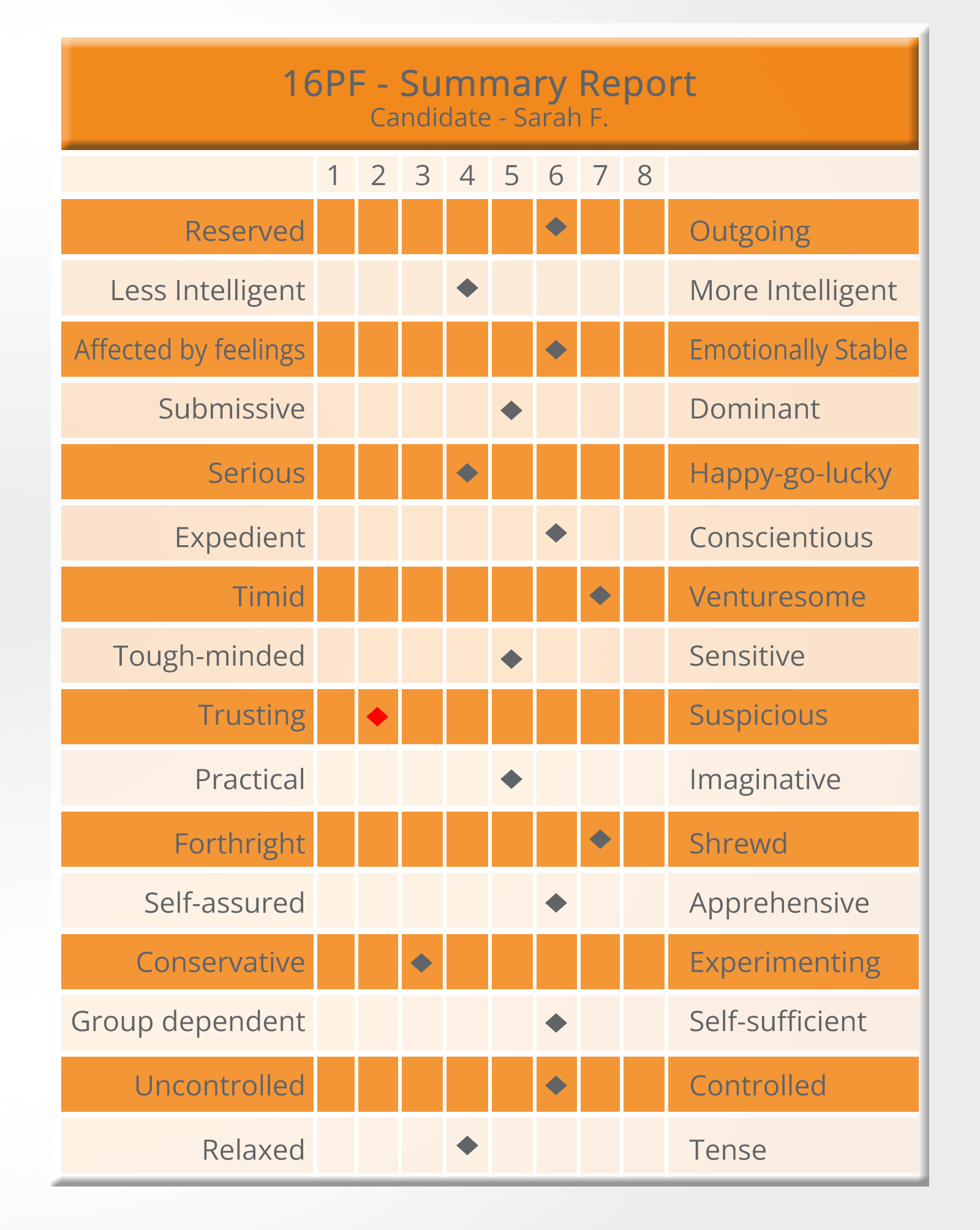
The interesting thing is that the individual who completed the questionnaire on which the profile is based has been successfully working in sales for over 20 years.
If she was looking for another sales job, her high score on the 'trusting' scale would almost certainly mean that her negotiating abilities would be ‘red-flagged’.
How could someone intrinsically so trusting be an effective negotiator?
If she was lucky and her previous track record was taken into account, she may get the opportunity to explain how she has managed to cope successfully in sales despite the high 'trusting' score.
More likely, in a field of other strong candidates, it would be enough to put her out of the running.
Human resources professionals would argue that personality questionnaires are not used in isolation and that they form only part of the whole selection process.
This is true as far as it goes, but you only need to look at the arithmetic of the recruitment process to see that the overwhelming majority of candidates need to be rejected for one reason or another.
Commercially available personality questionnaires produce very authoritative looking documentation and are often trusted to make evidence-based recruitment decisions, even though there can be anomalies in the data.
How to Pass Personality Tests – Top Tips (2026)
When it comes to preparing yourself for a personality test, the advice is usually limited to ‘just be yourself’.
This is a very inconsistent position to take.
After all, if you’re going to spend considerable time and effort preparing your resume and preparing for the interview, then why not prepare yourself for the personality questionnaire?
There are three approaches that you can take to the personality test:
- You can be totally honest and make no attempt to influence the outcome
- You can try to determine what characteristics you think the employer is looking for and try to fool the test accordingly
- You can learn enough about how these tests work so that you can be honest whilst ensuring that you don’t blow your chances because one aspect of your personality comes over as too extreme or inappropriate
Qualities like honesty, integrity, motivation, extraversion and leadership are only some of the personal attributes that personality tests attempt to measure.
They do however represent areas where you can easily ‘blow’ your chances if you don’t understand what the employer is looking for.
Some of the other personality traits or facets may be equally as important – this will depend largely on the job you are applying for as well as the employer.
How much you choose to try and influence the resulting personality profile is something only you can decide.
Common sense would suggest that you should not attempt to influence the results too much as they will probably be seen to conflict with your past achievements and with how you are perceived at the interview.
Work Personalities
Most of us find some aspects of our jobs require us to modify our preferred behavior.
Perhaps you’re more assertive at work than at home or maybe you’re more inclusive.
The point is that we can and do deal with the demands of the workplace by adopting a ‘work personality’.
Most of us do this fairly effortlessly.
We accept that the world of work is not about living within our comfort zone all of the time and we all have the ability to step outside of our natural behavioral preferences to get something done.

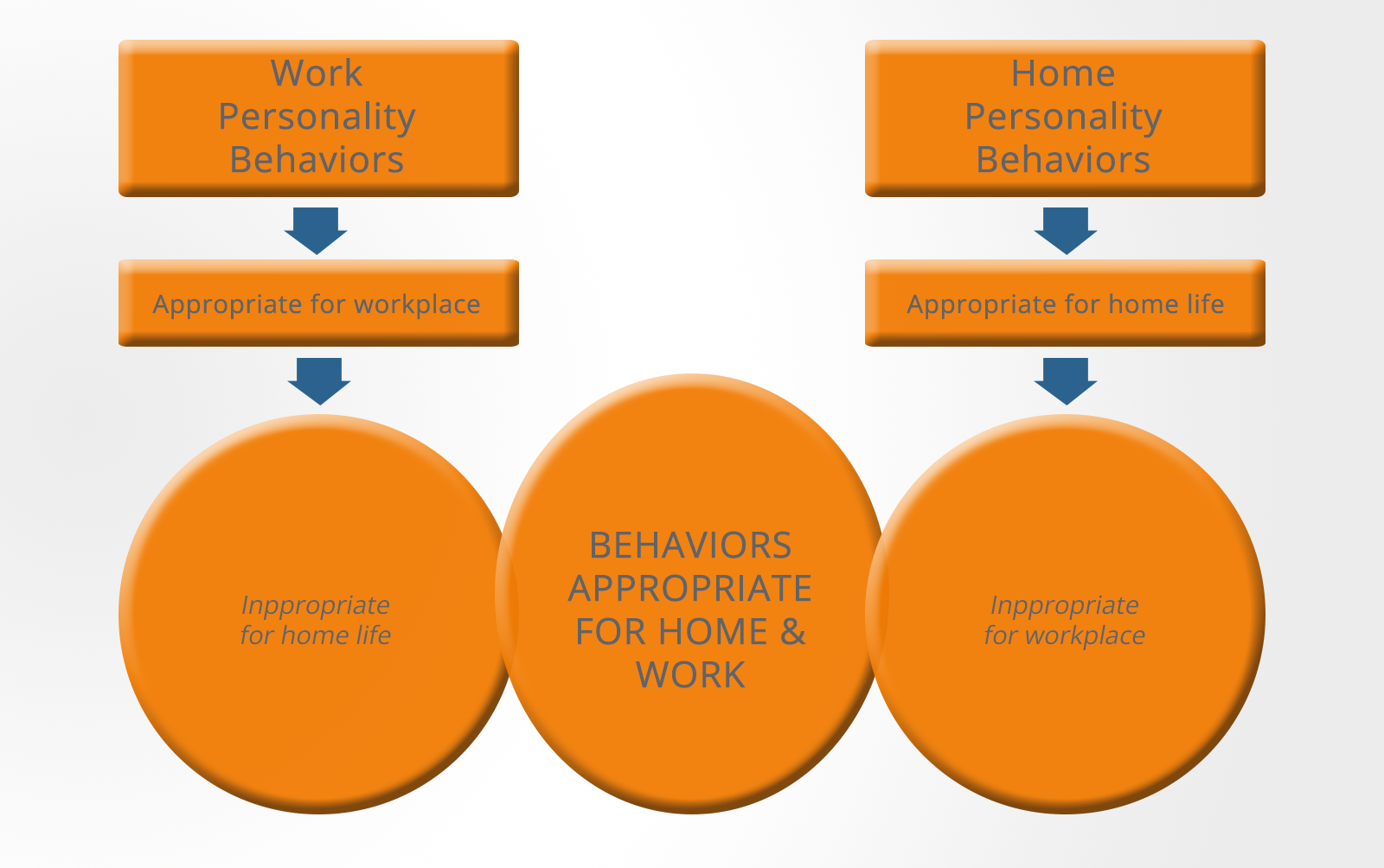
One argument that you may hear is that if you try to influence the test results then you will have to operate outside of your personality type for 40 hours a week.
This is overstating the case to the point of absurdity; very few people would even consider applying for a job which was totally unsuitable for them.
Anecdotal evidence and personal experience suggest that a significant number of people can behave very differently between home and the workplace.
If you recognize in yourself this dichotomy between workplace and non-workplace behaviors then you should answer all personality test questions from a workplace perspective.
For example, consider the following statement:
1. It's easy for people to see my moods
A) strongly disagree
B) disagree
C) neutral
D) agree
E) strongly agree
You may wear your heart on your sleeve at home, but if you are much more guarded at work then make this clear in your answer by selecting C) or B) rather than D).
Despite all of the platitudes to the contrary, either you have the ‘right’ personality or you get rejected in favor of someone who has.
If you want the job then you had better find out what it is that the employer is looking for and make sure that your personality questionnaire answers reflect it.
At the very least, you need to make sure that you don’t blow your chances because one trait comes over as too extreme or inappropriate.
Remember, almost all of the interviewees have to be rejected.
The amount of effort you need to spend on engineering your personality questionnaire answers depends on two factors:
-
The organization – Some organizations have a distinct personality type that they actively try to recruit. This will usually be obvious from both their marketing material and their reputation. Any organization that promotes its people as being of a certain ‘type’ will probably be using personality questionnaires to reject anyone who doesn’t fit with the corporate image that they want to promote. This is common in management consultancies and in jobs above a certain level in big corporations.
-
The job – Some interviewers suffer from a very blinkered approach to what type of personality is required for particular jobs. For example, if the profile for successful salesmen indicates that extroversion is a desirable characteristic, you had better be sure that you score highly on this trait if you want the job.
Whilst you don’t want to pursue jobs that you are obviously unsuited for, you need to make sure that your personality questionnaire answers won’t cause any red-flags to appear in selection for jobs that you feel comfortable with, or where you already have a track record.
Frequently Asked Questions
The modern workforce is made up of people from a diverse array of ethnic and cultural groups, including many persons for whom English is not the primary language.
Some of these individuals may experience difficulty on standardized tests due to cultural differences or lack of mastery of the English language.
Depending on the nature of the job for which they are applying, this could mean that their test scores will not accurately predict their true job potential.
These situations must be handled with professionalism and sensitivity.
Properly handled, this can be accomplished without compromising the integrity of the assessment process.
Accommodation may involve ensuring physical accessibility to the test site, modifying test equipment or tests, or providing other forms of assistance.
Giving extra time for certain kinds of tests to test takers with dyslexia or other learning disabilities and administering a braille version of a test for the blind may be examples of reasonable accommodation.
Despite the claims of test producers, it is very easy to cheat.
This is supported by a study conducted by the American Psychological Association which found that over 80% of job applicants who were hired after taking a personality test had intentionally manipulated their answers to make themselves look better.
Certainly, most tests contain some so-called impression control questions, designed to catch out candidates who are trying to give an overly good impression.
Unfortunately for the test designers, they have yet to develop any impression control questions which are not blindingly obvious.
These questions almost invariably use the words; ‘always’ or ‘never’ in relation to something where ‘occasionally’, ‘very occasionally’ or ‘usually’ would be an honest response.
Typical impression control questions look like this:
- I always finish what I start
- I always tell people exactly what I think
- I am always happy
- I can't remember ever being late for an appointment
- I have never acted on impulse
- I have never been annoyed with a coworker
- I have never disappointed anyone
- I have never failed to complete a work assignment on time
- I have never felt alone
- I have never felt angry at a supervisor or manager
- I have never felt sad
- I have never hurt anyone's anyone's feelings
- I have never lost a night's sleep worrying about something
- I have never made a mistake at work
- I never regret my decisions after I make them
- I never tell white lies
- I never worry if I make a mistake
- I've never been deliberately rude to anyone
- None of my close friends has ever upset me
- All of my work has been appreciated and valued by others
In all cases, you are being asked to agree to some unconditional statement – which is what gives these questions away.
You should answer these impression control questions honestly as disagreeing with a statement like ‘I never tell white lies’ will obviously not count against you.
The only area where there is any room for confusion about impression control questions is the honesty/anger/stress questions.
These are the only other types of questions where you may see ‘always’, ‘never’ and other unconditional statements and be expected to strongly agree or strongly disagree with them.
So, whilst you should strongly agree with a statement like: 'I have never become angry at work', it is OK to disagree with the statement 'I have never felt angry at a supervisor or manager'.
This is because the first statement is asking you if you have ever displayed unacceptable behavior at work, and you should obviously answer in the negative. The second statement is asking if you have EVER FELT angry at a supervisor or manager.
If your answer claims that you have never felt anger, then this suggests that either you are lying or you don't care sufficiently about your job to ever feel angry, neither of which makes you look like a desirable employee.
It is worth making a list of the honesty/anger/stress questions and the impression control questions and working through these systematically until you can appreciate the (sometimes) subtle differences between the two.
As a general rule, it is OK to admit to negative thoughts and feelings but do not under any circumstances admit to negative behavior in the workplace.
How much you choose to try and influence the resulting personality profile is something only you can decide.
Common sense would suggest that you should not attempt to influence the results too much as they will probably be seen to conflict with your past achievements and with how you are perceived at the interview.
The best approach is probably to take the time to understand how these tests try to measure your personality and then to make sure that you don't allow any aspects of your personality to be perceived as inappropriate for the job.
Taking a personality test is a great way to evaluate yourself. These tests help you identify and understand your strengths, weaknesses, and motivations. They suggest careers and roles that best suit you, and they help refine your social skills and personal development.
Knowing your traits and shortfalls allows you to manage social interactions and situations better – particularly in the workplace.
As personality tests assess so many different factors, it is difficult to say which one is the most accurate.
The two most popular ones are the Myers-Briggs test (MBTI) and the Big 5.
The MBTI assesses whether someone is an extrovert or introvert, has a sensing or intuitive preference when processing information and makes decisions based on feelings or thinking.
The results yield one of 16 personality types.
The Big 5 assesses openness, conscientiousness, extroversion, agreeableness, and neuroticism. It is considered the most scientifically sound personality test. Though all personality tests do have their limits.
Some argue that the Myers-Briggs test is statistically validated but not scientifically validated. This means that there is enough data available to back the theories Myers and Briggs created.
However, many argue that the Myers-Briggs is not accurate enough to be scientifically validated and therefore not a reliable measure of your personality.
The most popular personality tests are the Big 5, Myers-Briggs Type Indicator, Caliper Profile, 16 Personality Factor Questionnaire, SHL Occupational Personality Questionnaire, Birkman Method, 9 Personalities & Enneagram test, NEO Personality Inventory test, and the Jung Personality Test.
Due to the amount of research and analysis that has gone into personality tests, they can be considered a reliable measure of your character.
However, as with any test, there are limits and negatives.
Sometimes the questions or scenarios are very black and white, asking for one reaction or statement. But the reality is, that we often react differently in the same situations. Our reactions come from the circumstances at the time and it is sometimes impossible to say for sure what our behavior will be.
The questions are also vague. In reality, we would have much more information to assess the situation or make a judgment.
The wording of the questions can sometimes be confusing and unclear.
It is also often the case that people lie on their tests because they want to appear as a certain type of person. If the reliability of personality tests comes from the data collected, then a large percentage of it is inaccurate.
Some believe the 16 personalities test is scientifically accurate. But many others fail to see it as a scientifically credible test. Instead, it is considered a statistically accurate test.
Due to the number of people who have completed the 16 personalities test and the number of revisions it’s had, there is a high chance of it being accurate. But there are also many instances where the results have been inaccurate, either because of misunderstandings, generalizations, or untruthful answers.
The best websites for personality tests are:
With the continuous development of technology such as AI, personality testing can become more personalized and therefore more accurate.
It is also believed that emotional technologies that include automated coaching will play a role in future personality testing.
The Metaverse and virtual reality will also play a part, allowing candidates to work through scenarios as they would in real life.
This feeling of reality puts the candidate at ease and allows them to think and operate more as themselves.
No, you cannot fail a personality test. There are no right or wrong answers. Instead, the recruiter will use your answers to determine how much of a match you are for the company’s culture.
So while you cannot fail a test, you can be unsuitable for a company.
People fake personality tests because they want the role they are testing for.
Many recruiters and employers use personality tests in the first stage of recruitment to eliminate a large number of unsuitable candidates.
Depending on the role, these pre-employment tests will measure aptitude for a topic or specialty, or they will assess your personality in comparison to the company culture.
Candidates will lie or manipulate their answers to appear as the perfect person for the role.
The two personalities that are the easiest to fake are conscientiousness and neuroticism.
When applying for a job, the best one to fake out of the two is conscientiousness.
These personality types are methodical, dependable and organized. Knowing how a conscientious person thinks and what qualities they possess helps you select the answers that they would.
Summary
If you are going to take a psychometric test, aptitude test or ability test as part of the recruitment process then you should download free psychometric tests from this website and work through them before you do the real thing.