
Aptitude Tests: Full Guide (2026)
Updated October 11, 2024


What Are Aptitude Tests?
Aptitude tests (sometimes referred to as cognitive ability tests) are ability tests designed to assess your logical reasoning or mental ability.
Aptitude tests measure abilities such as:
Why Do Employers Use Aptitude Tests?
Sometimes using work history and an interview is just not enough when making a final selection for employment.
An aptitude test is an efficient way to test whether a candidate has enough experience to efficiently perform the duties of the job.
Aptitude tests allow unsuitable candidates to be easily filtered out of the application process.
Aptitude tests have a standard scoring system which makes it easier to compare candidates against each other.
The advantages of online aptitude testing include the immediate availability of results and the fact that the test can be taken at employment agency premises or even at home.
This makes online testing particularly suitable for initial screening, as it is cost-effective.
What to Expect When Taking an Aptitude Test
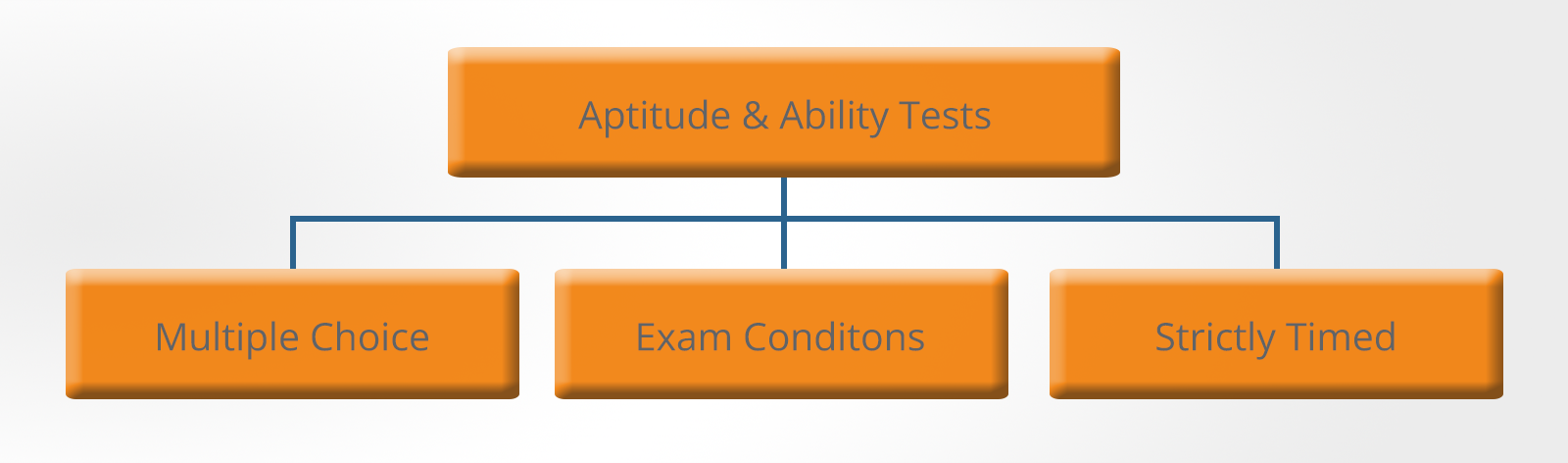
Aptitude tests consist of multiple-choice questions and are administered under exam conditions, usually online.
They are strictly timed and a typical test might allow 30 minutes for 30 or so questions.
You will usually find that there are more questions than you can complete in the time allowed and the aim is simply to give as many correct answers as you can.

Prepare for Any Job Assessment Test with JobTestPrep
Aptitude and ability tests can be classified as speed tests or power tests:
-
In speed tests, the questions are relatively straightforward and the test is concerned with how many questions you can answer correctly in the allotted time. Speed tests tend to be used in selection at the administrative and clerical level.
-
A power test, on the other hand, will present a smaller number of more complex questions. Power tests tend to be used more at the professional or managerial level.

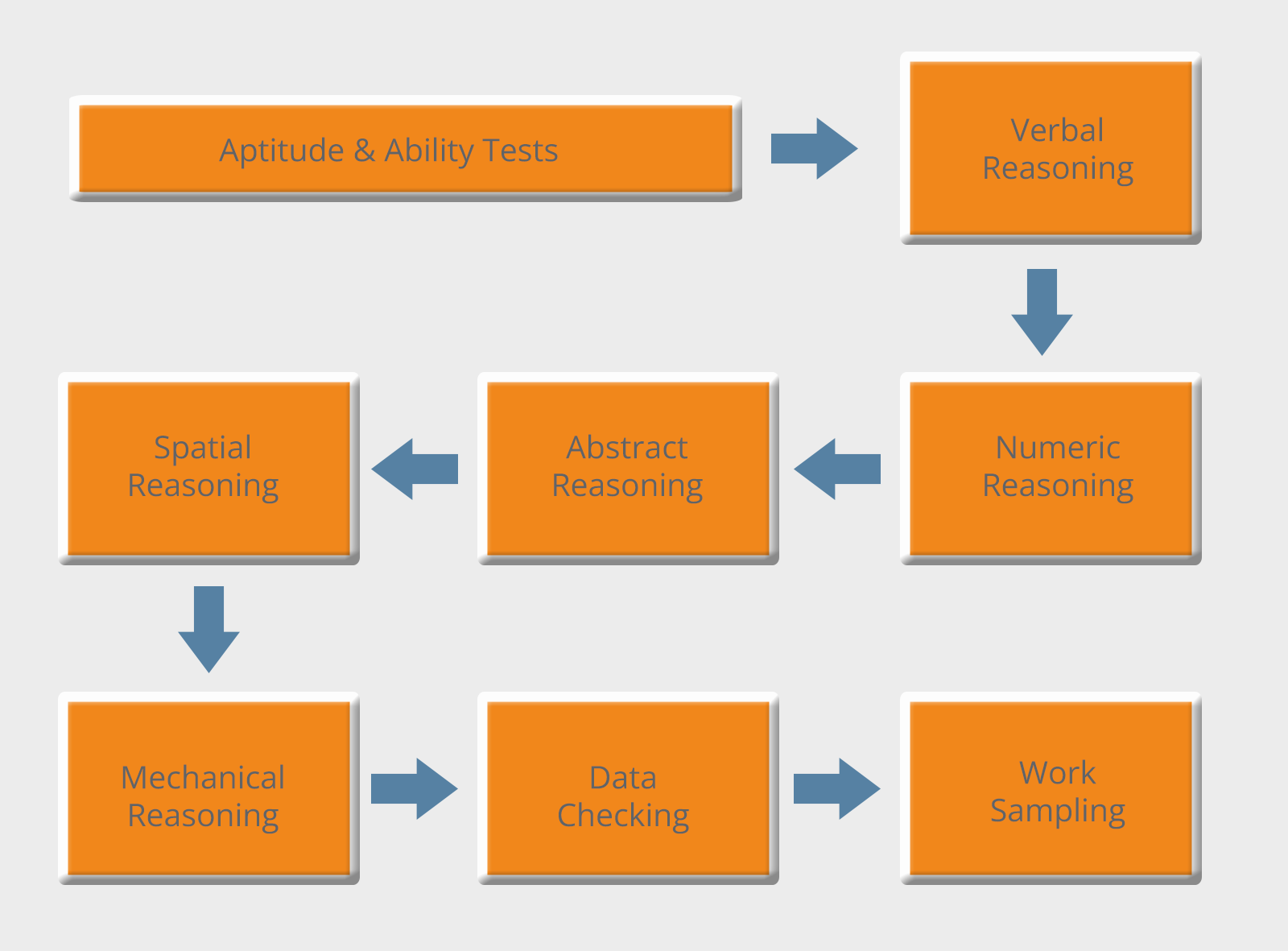
There are at least 5,000 aptitude and ability tests on the market. Some of them contain only one type of question (for example, verbal ability, numeric reasoning, etc.) while others are made up of different types of questions.
Types of Aptitude Tests in 2026
The main categories of aptitude test are:
- Clerical
- Verbal reasoning
- Numerical reasoning
- Abstract reasoning (sometimes called diagrammatic reasoning)
- Spatial ability
- Mechanical reasoning
Clerical Aptitude Tests/Concentration tests
Clerical aptitude tests and concentration tests are used to determine a person’s level of concentration and accuracy.
These tests are usually scored on both speed and accuracy.
They are most often used when selecting candidates for administrative and clerical jobs where mistakes can have serious or expensive consequences.
This includes areas like financial services, legal services and healthcare.
Click here to practice concentration tests now.
Prepare for Any Job Assessment Test with JobTestPrep
Verbal Reasoning Tests
Verbal reasoning aptitude tests are used to measure a person’s comprehension level, their ability to spell, use grammar correctly and understand terms.
They are particularly challenging for people who do not speak English natively.
-
Comprehension level is often tested by providing a paragraph or several paragraphs and asking questions about it.
-
The spelling portion involves presenting the test taker with four or five different spellings of the same word or presenting four or five different words and having the test taker choose the word that is correctly spelled.
-
The grammar section will present several sentences and will ask the test taker to pick the grammatically correct sentence.
-
Another section involves understanding terms and their definitions. You may be asked to identify the definition of a word or to choose a word that is opposite of the word that is underlined or in bold font.
These questions appear in most general aptitude tests because most jobs require you either to understand and make decisions based on verbal or written information or to pass this type of information to others.
Prepare for Any Job Assessment Test with JobTestPrep
If you need to prepare for a number of different employment tests and want to outsmart the competition, choose a Premium Membership from JobTestPrep.
You will get access to three PrepPacks of your choice, from a database that covers all the major test providers and employers and tailored profession packs.
Prepare for Any Job Assessment Test with JobTestPrep
Numerical Reasoning Tests
Numerical reasoning aptitude tests are meant to measure the competency level of a person based on their understanding of numbers, number sequences, graphs, tables and calculations, such as mathematical equations.
In other words, this type of test is used to determine basic numeracy.
These tests are directly applicable to many administrative and clerical jobs but can also appear as a component of graduate and managerial tests.
In more complex data interpretation and numerical critical reasoning questions, blocks of information are provided that require manipulation and interpretation.
These questions appear in most general aptitude tests because employers usually want some indication of your ability to use numbers even if this is not a major part of the job.
Prepare for Any Job Assessment Test with JobTestPrep
Abstract/Diagrammatic Reasoning
Abstract reasoning and diagrammatic reasoning tests measure your ability to identify the underlying logic of a pattern and then determine the solution.
Abstract reasoning ability is believed to be the best indicator of fluid intelligence and your ability to learn new things quickly.
These tests are of particular value when selecting people for technical jobs which involve working with abstract ideas or concepts.
However, as they also provide the best measure of your general intellectual ability, you will usually find some questions of this type whichever particular tests you are given.
Prepare for Any Job Assessment Test with JobTestPrep
Spatial Ability Tests
Spatial ability tests measure your ability to manipulate shapes in two dimensions or to visualize three-dimensional objects presented as two-dimensional pictures.
Spatial ability is required in production, technical and design jobs where plans and drawings are used; for example, engineering, architecture, surveying and design.
It is also important in some branches of science where the ability to envisage the interactions of three-dimensional components is essential.
Spatial ability questions often involve the visual assembly and the disassembly of objects that have been rotated or which are viewed from different angles, or objects that have different markings on their surfaces.
Prepare for Any Job Assessment Test with JobTestPrep
Mechanical Reasoning Tests
Mechanical reasoning tests are designed to assess your knowledge of physical and mechanical principles; for example, pulleys, levers, simple electrical circuits, etc.
No specialist knowledge is required to answer these questions, only an understanding of the principles.
Mechanical reasoning questions are used to select for a wide range of jobs including the military (Armed Services Vocational Aptitude Battery), police forces, fire services, as well as many craft, technical and engineering occupations.
Prepare for Any Job Assessment Test with JobTestPrep
Fault Diagnosis Tests
Fault diagnosis tests are used to select technical personnel who need to be able to find and repair faults in electronic and mechanical systems.
As modern equipment of all types becomes more dependent on electronic control systems (and arguably more complex) the ability to approach problems logically to find the cause of the fault is increasingly important.
Prepare for Any Job Assessment Test with JobTestPrep
Data Checking Tests
In data checking tests, you will usually be given two columns of data to check for consistency and you will be asked to mark up any differences.
This type of test is used to measure how quickly and accurately errors can be detected in data.
It is used to select candidates for clerical and data input jobs, particularly where accuracy is important; for example, accounting and banking.
In these tests, you will usually be given two columns of data to check for consistency and you will be asked to mark up any differences.
Prepare for Any Job Assessment Test with JobTestPrep
In-Tray Exercises
In-tray exercises are a sample of the work that you will be expected to do.
Often, in-tray exercises involve interacting with a fake email program and selecting responses to incoming messages via multiple-choice questions.
These types of tests can be very broad-ranging.
They may involve exercises using a spreadsheet if the job is administrative, or they may include giving a presentation.
WikiJob has a good run-down of in-tray exercises.
How Will Your Aptitude Test Be Scored?
Your test result will usually be a percentile score that is compared to others taking the test.
Usually, scores in the upper 25% of the range (the ‘top quartile') are deemed to have passed.
Ideally, your score will then be compared with the results of a control group that has taken the tests in the past.
This control group could consist of other graduates, current job holders or a sample of the population as a whole. Your reasoning skills can then be assessed in relation to this control group and judgments made about your ability.
More commonly, your scores will be compared to the other candidates who took the test at the same time. Whilst this does not represent best practice due to the small size of the sample, it is often what happens in real life.
How to Prepare to Take an Aptitude Test in 2026
Spend your preparation time wisely.
Many people find themselves with only one or two days to prepare for aptitude tests.
This is enough time to prepare, provided that you are systematic.
How to prepare:
Step 1. Find Out What Type of Aptitude Test You Are Taking
You may need to ask.
Most employers will give you a few practice questions to familiarise yourself with the test setup.
Sometimes, you can determine the provider of the test (the big names are SHL, Previsor, Cubiks, among others) and find tests geared for those providers, as well as more sample questions on their websites.
Step 2. Research the Types of Question You Will Face
Use the information on this website to get an idea of the different types of questions.
Try to speak to other candidates who’ve taken the test if you can.
Step 3. Do Practice Tests Online
We recommend JobTestPrep.
An example of an aptitude test is the Cognitive Abilities Test (CogAT), which assesses a person's cognitive skills, including reasoning and problem-solving abilities. This standardized test is often used in educational settings to evaluate students' learning potential and academic aptitude.
A general aptitude test is designed to measure a broad range of cognitive abilities, including numerical, verbal, and abstract reasoning. These tests provide insights into an individual's overall potential and learning capacity.
In psychology, an aptitude test is a standardized assessment that measures an individual's inherent or acquired ability to perform specific tasks or acquire certain skills. It aims to predict a person's potential for success in a particular area.
Aptitude refers to a person's natural ability, talent, or capacity to acquire and apply specific skills. It indicates the potential for success in a particular field or task.
A good score on an aptitude test depends on the specific test and its scoring system. Generally, a score above the average range indicates a strong aptitude for the assessed skills or abilities.
The difficulty of aptitude tests varies based on the content and the individual's familiarity with the assessed skills. Some may find them challenging, while others may excel depending on their natural abilities and preparation.
Aptitude tests are commonly used by employers in the hiring process to assess candidates' suitability for specific roles. Educational institutions also use aptitude tests for admissions, and career counselors may use them to guide individuals toward suitable career paths.