It is perfectly normal to feel some stress and
nervousness when you are told that you need to prepare for an
Aptitude Test as part of the selection process. This can be a

particular problem if you haven’t taken this type of test before.
Most of the nervousness is simply a fear of the unknown and a
feeling that you will ‘let yourself down’ and that the test will
not be a fair reflection of your strengths and abilities.
The most effective solution is to take direct action and
prepare
for aptitude
tests in the most systematic and efficient way possible. You

can influence your scores in these tests significantly by
understanding the question types and practicing them. Not only
will this improve your test scores and increase the chance of you
getting to the next stage of the selection process, but by taking
positive action you will tackle the cause of the stress directly.
Aptitude tests are structured, pencil and paper (or sometimes
computer-based) exercises, often presented in the form of
multiple-choice questions. They are designed to assess your
reasoning abilities independently of your academic or cultural
background. The tests that are used in the job recruitment and
selection process can be classified as follows:

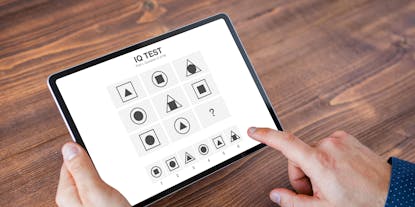
Abstract Reasoning Tests
Assess your ability to understand complex concepts and assimilate
new information beyond previous experience. The test items require
you to recognize patterns and similarities between shapes and
figures. As a measure of reasoning it is independent of attainment
and can be used to provide an indication of intellectual
potential.
Numeric Ability Tests
Assess your ability to use numbers in a logical and rational way.
These tests require only a basic level of education in order to
successfully complete and are therefore measuring numerical
ability rather than educational achievement. The test items
involve number series, numerical transformations, relationships
between numbers and numerical computations.
Verbal Ability
Tests
Assess your ability to perceive and understand concepts and ideas
expressed verbally. While these test are designed to measure
reasoning ability rather than educational achievement, it is
generally recognised that verbal reasoning test scores are
sensitive to educational factors.
Spatial
Ability Tests
Assess your ability to manipulate shapes in two dimensions or to
visualize three-dimensional objects presented as two-dimensional
pictures. There is a strong correlation between high spatial
visualization skills and success in science and mathematics.
Mechanical Aptitude Tests
Assess your understanding of physical and mechanical principles
including an understanding of cause-effect relationships between
mechanical components. Mechanical reasoning tests are used to
select for a wide range of jobs including the military (Armed
Services Vocational Aptitude Battery), police forces, fire
services, as well as many engineering occupations.
Some organizations apply
psychometric testing in ways that are
directly relevant to the job. For example, you may only have to
take a
numerical reasoning test if the job you're applying for
requires good numerical skills. However, many organizations use a
battery of tests as a matter of routine irrespective of the
particular demands of the job. In either case your best strategy
is to ask what types of test you are expected to take and prepare
for aptitude tests thoroughly.

Everything you need to pass psychometric tests
|