
Free Practice Spatial Ability Tests
Updated November 15, 2023


Spatial ability questions measure your ability to form mental images, and visualize movement or change in those images.
Prepare for Any Job Assessment Test with JobTestPrep
Spatial ability tests often involve the visual assembly and the disassembly of objects that have been rotated or which are viewed from different angles.
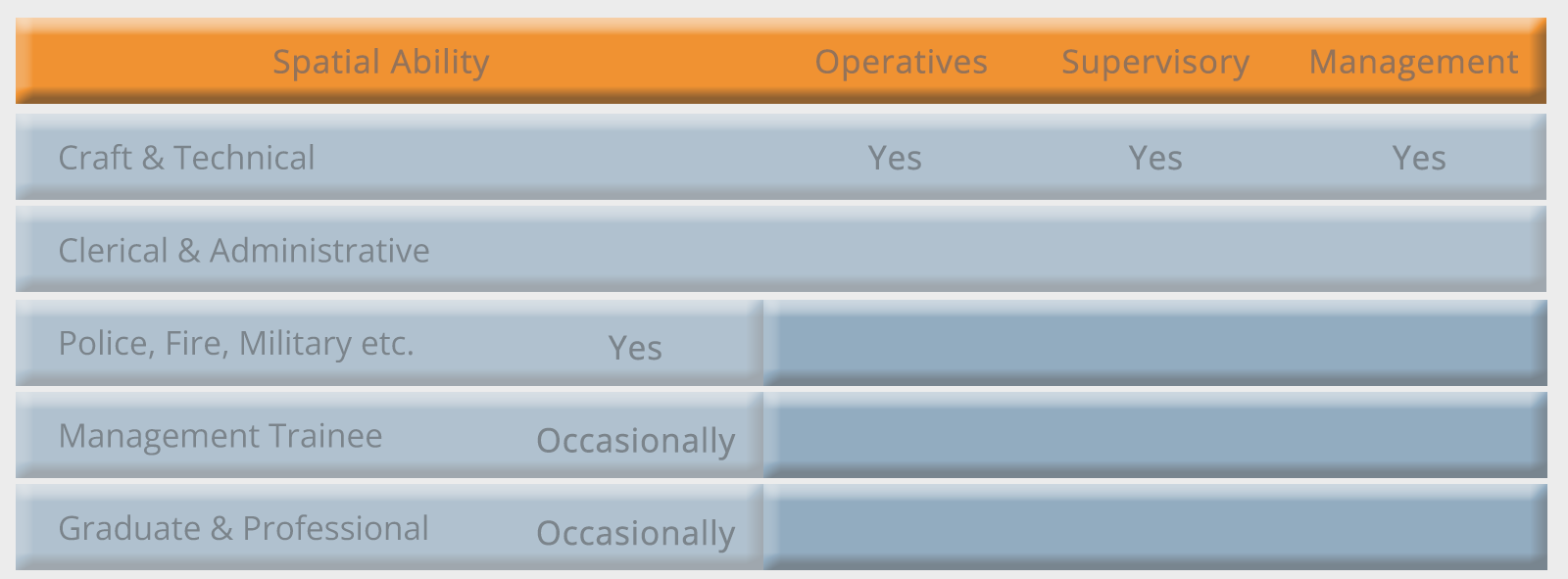
Spatial ability is required in production, technical and design jobs where plans and drawings are used; for example, engineering, architecture, surveying and design.
However, it is also important in some branches of science where the ability to envisage the interactions of three-dimensional components is essential.
At first sight some of these questions look very similar to abstract reasoning questions – they are not.
Spatial ability questions are concerned only with your ability to mentally manipulate shapes, not to identify patterns and make logical deductions.
They are not routinely used in graduate and management level tests unless the job specifically requires good spatial skills.

This sample question paper contains 45 questions and has a suggested time limit of 20 minutes.
The questions are presented in Letter/A4 format for easy printing and self-marking.
All spatial ability tests rely on you being able to imagine what would happen in your mind's eye.
If you need to prepare for a number of different employment tests and want to outsmart the competition, choose a Premium Membership from JobTestPrep.
You will get access to three PrepPacks of your choice, from a database that covers all the major test providers and employers and tailored profession packs.
Prepare for Any Job Assessment Test with JobTestPrep
Unfortunately, about 5% of the adult population find it impossible to imagine two-dimensional shapes being moved through a third dimension.
This is thought to be because there is a genetic factor involved in spatial reasoning ability.