
Verbal Reasoning Ability Tests: 17 Free Example Questions
Updated July 28, 2024


What Is a Verbal Aptitude Test?
A verbal aptitude test (also known as a verbal reasoning or **verbal ability test is a standardized test designed to assess a job candidate’s knowledge of English as well as their reasoning ability.
These tests are widely used since most jobs require you either to understand and make decisions based on verbal or written information or to pass this type of information to others.
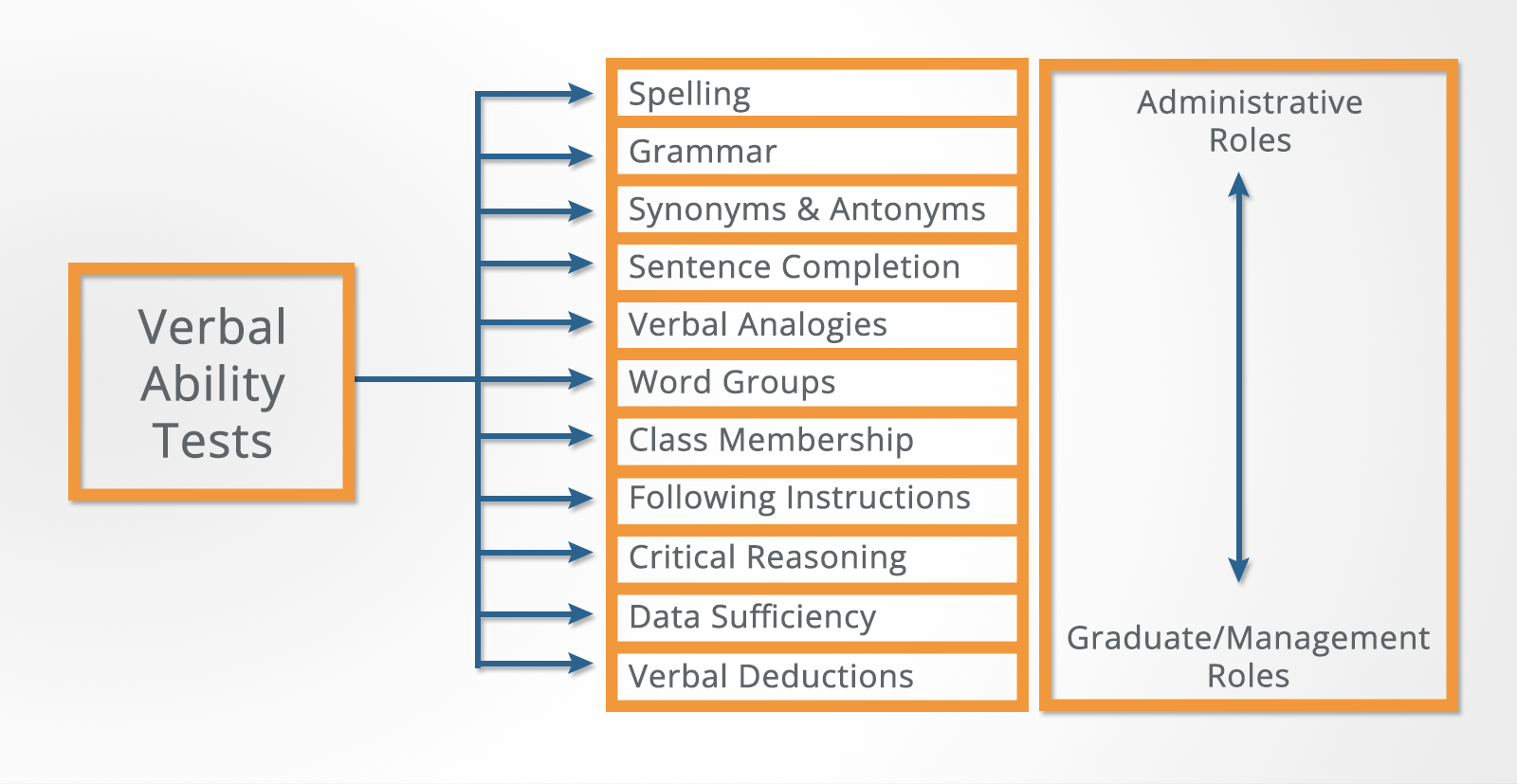
In practice, the more straightforward types of questions (spelling, grammar and instructions) tend to be more applicable to administrative roles and the reasoning and deduction type of questions to management roles.
Verbal aptitude tests can include questions on:
- Grammar
- Comprehension
- Verbal analogies
- Following detailed written instructions
- Spelling
- Sentence completion
- Comprehension
- Word groups
- Critical reasoning
- Verbal deductions
Because they depend on understanding the precise meaning of words, idioms and the structure of language, they discriminate very heavily towards native speakers of the language in which the test has been developed.

Why Do Employers Use Verbal Aptitude Tests?
Most employers who use psychometric tests in the selection process will include a verbal aptitude test as there are very few careers that don't require the ability to understand, analyze and interpret written information.
Verbal aptitude tests also give employers the best indication of how you will be perceived by other people, particularly customers and co-workers. This is because most of us make judgments about others based on the accuracy and clarity of the language they use to communicate.
Also, it is not always easy to assess whether someone can analytically interpret information and make sound judgments based on their conclusions.
This is particularly true if individuals are applying for their first management job and do not have a track record of successful decision making.
Verbal aptitude tests will require you to demonstrate your ability to make logical decisions and even to recognize that insufficient data has been provided for a definitive answer to be reached, as would be the case in many real-life situations.
When trying to decide between the final few applicants, this test can play a vital role in an employer’s decision-making process and can also save time during the pre-screening process.
Prepare for Any Job Assessment Test with TestHQ
What to Expect on a Verbal Aptitude Test
Verbal tests evaluate your ability to spell words correctly, use correct grammar, understand analogies and analyze detailed written information.
There are two types of verbal questions that appear in psychometric tests:
-
Speed questions which are so easy that with unlimited time all but the most inept of people taking the test could answer them all successfully. However, the time allowed to complete the test is so short that even the ablest person is not expected to finish. This means that the result depends on the number of correct answers made in the relatively short time allowed.
-
A power test contains questions that vary in difficulty and no one is expected to get all of the answers correct even with unlimited time. In practice, a definite but ample time is set for power tests.

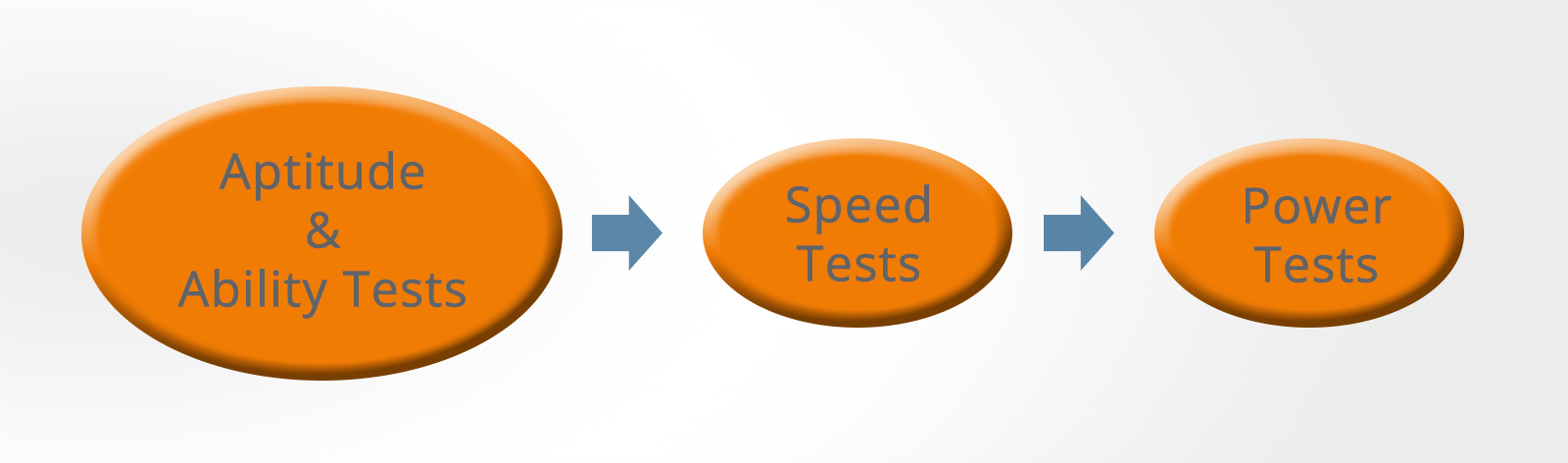
Verbal aptitude tests can be divided into tests of simple verbal ability (for example, spelling and grammar) and verbal reasoning (or critical reasoning). You may also face tests that involve both of these types of questions.
Simple Verbal Ability Tests
Simple verbal ability tests usually consist of 30 to 40 questions which need to be completed in 15 to 20 minutes. They are speed tests in that they don’t require very much reasoning ability. You either know the answer or you don’t.
These tests use grammatical questions, spelling, terms and definitions, and reading passages to evaluate a person’s aptitude level.
Grammatical questions can be included in a few different ways:
The first is to present a sentence in four different ways, changing the placement and usage of commas, semicolons, uppercase and lower case letters, and punctuation. The test taker must then choose the sentence that uses the correct grammar.
Another way is to use four completely different sentences and ask the test taker to choose the grammatically correct sentence.
Spelling is tested similarly.
Terms and definitions are tested by identifying a word in a sentence, in bold or underlined, and asking the test taker to either give the definition of the word or to choose a synonym or antonym of the outline term.
Comprehension is often measured by having a person read a passage or series of passages that might be one or multiple paragraphs long. Candidates are asked to answer several questions that were answered in the passage.
These tests are often strictly timed leaving a limited amount of time for the test taker to complete each question, with the standard being one minute per question.
Verbal Reasoning Tests
Verbal reasoning tests usually consist of 10 to 15 questions that need to be completed in 20 to 30 minutes and are designed to test your reasoning and problem-solving ability rather than your facility with the language.
These questions may take the form of relatively straightforward comprehension exercises or more complex statements which you need to analyze and understand to obtain the correct answer.
These questions measure your ability to understand concepts and ideas expressed verbally.
Prepare for Any Job Assessment Test with TestHQ
Verbal Aptitude Test - Question Types
Spelling Questions
Questions where you have to identify incorrectly spelled words are common in all levels of verbal aptitude tests.
These are usually speed questions that test your ability to use English correctly.
The test designer needs to choose words that are fairly common and in regular usage but which are often spelled incorrectly.
There would be little point in using obscure words which only a small percentage of candidates could be expected to know.
This means that you will almost certainly have heard of the word and know its meaning and you will find that the same words tend to appear in many different suppliers’ tests.
If you have been out of the education system for a while or you are not an avid reader, you may be surprised how much your spelling and grammar have deteriorated.
Since most of us use word processors with the ‘auto-correct’ option switched on, it is very easy not to concentrate on spelling words correctly and many people are out of practice when it comes to more formal English usage.
However, this is a skill that can be significantly improved with practice.
Example questions:
1. Which of the following words are incorrectly spelled?
A) separate
B) ordnance
C) obviously
D) sucess
E) none of these
2. Choose the pair of words that best completes the sentence:
The -------- of the timetable caused some ----------
A) rivision/inconvenience
B) revision/inconvenience
C) revission/inconvenience
D) revition/inconvenience
3. The following list of 20 words contains 10 that are incorrectly spelled. Write the letter that corresponds to each incorrectly spelled word in the answer box.
A) occurence
B) dissipate
C) weird
D) accommodate
E) embarassment
F) ecstacy
G) repetition
H) batallion
I) dispair
J) irritable
K) accidently
L) liaison
M) memento
N) millenium
O) yield
P) existance
Q) independent
R) insistant
S) excede
T) privilege
Prepare for Any Job Assessment Test with TestHQ
Missing Word Questions
These questions are designed to measure your vocabulary, specifically your understanding of precise word meanings.
You will usually be offered a choice of four or five words, any of which could complete the sentence.
These questions are relatively straightforward but because more than one of the options will complete the sentence satisfactorily, you must read the sentence carefully.
Example questions:
1. Which of these words completes the sentence in a way that makes the most sense?
A spirit level should be used to ensure that the surface is -----------
A) straight
B) flat
C) horizontal
D) parallel
E) aligned
2. Which of these words completes the sentence in a way that makes the most sense?
He avoided --------- because he was ------------
A) redundency
B) indispensable
C) redundancy
D) indispensible
Word Relationship Questions
Word relationship questions (also known as verbal analogy questions) appear in nearly all levels of verbal aptitude tests, although the vocabulary will tend to be more extensive in tests aimed at graduate and management level.
To answer word relationship questions, you need an understanding of the precise meaning of the words in the question and to establish the relationship between them. These questions test your reasoning ability as well as your vocabulary.
Be sure that you understand what an analogy is before you start. Every analogy expresses a relationship between two things.
The important thing to remember is that there is often more than one possible answer but you are looking for the word which best completes the analogy or group.
These questions do not usually include difficult or problematic vocabulary words – most of the words used will be familiar to you. It is the fact that many words in English have multiple meanings that can make these questions tricky.
Solving word relationship problems involves three separate processes:
- You have to understand the meaning of the question words
- You have to determine the relationship between the words
- You have to be able to complete the analogy so that each pair of words has the same relationship
Verbal analogies can be classified into specific categories; for example, materials, taxonomic relationships, temporal relationships, parts of speech, etc. The list is almost endless.
It is this relationship that you must understand as you look at the options required to complete the analogy.
Here are some tips for answering:
-
First, try to understand the relationships expressed in the question words.
-
Then, choose your answer so that the relationship in the first pair of words is similar to the relationship in the second pair of words in terms of meaning, order and function.
-
Check that the parts of speech used in the two sections of analogy are consistent and follow the same sequence. For example, if the first pair of words contains an adjective and a noun in that order, then the second pair of words must contain an adjective and a noun in the same order. Test designers are very fond of offering answer options that initially seem credible but where this golden rule is broken.
Word relationship questions are sometimes written in abbreviated form using symbols like those used to describe a mathematical ratio.
In this case, a colon represents the words ‘is to’.
For example, ‘success : passed’ should be read as ‘success is to passed’.
Similarly, two colons (::) should be read as ‘in the same way as’.
For example, ‘sail : cloth :: oar : wood’ means that ‘sail is to cloth in the same way as oar is to wood’. This is true because a sail is made of cloth and an oar is made of wood.
Example questions:
1. Which of these is the missing word?
kick, ______, walk
A) throw
B) toes
C) shin
D) feet
E) hand
If you need to prepare for a number of different employment tests and want to outsmart the competition, choose a Premium Membership from TestHQ.
You will get access to three PrepPacks of your choice, from a database that covers all the major test providers and employers and tailored profession packs.
Prepare for Any Job Assessment Test with TestHQ
2. ‘medicine’ is to ‘illness’ as ‘law’ is to _______.
A) anarchy
B) discipline
C) treason
D) etiquette
3. Identify the relationship between the word group in the question. Circle the answer which fits best with the group.
barber, florist, draper
A) flower
B) cloth
C) milliner
D) hair
Prepare for Any Job Assessment Test with TestHQ
Word Meaning Questions
These questions are designed to measure your vocabulary and your understanding of word meanings.
These questions often use words which have either the same or opposite meanings (synonyms and antonyms) and dictionary definitions and word pairs.
Another type of word meaning question uses words that sound similar but have different meanings. These are called homophones.
For example, words like 'allude’ and ‘elude’.
‘Allude’ means ‘referred’ and ‘elude’ means ‘escaped from’.
The test designer needs to choose common homophones that are in regular use and this leaves a relatively restricted list to choose from. This makes it easy for you to revise the most common ones.
Example questions:
1. Which of two of these words are opposite in meaning?
A) lose
B) winner
C) victor
D) loser
E) vanquish
2. Which of these words is the odd one out?
A) swindle
B) harass
C) provoke
D) annoy
E) pester
3. Which word does not have a similar meaning to – ‘outcome’?
A) affect
B) result
C) upshot
D) effect
Prepare for Any Job Assessment Test with TestHQ
Verbal Comprehension Questions
Verbal comprehension questions consist of a short passage and some related questions.
Verbal comprehension questions appear in all levels of verbal aptitude tests but might be more detailed and technical in graduate and management level tests.
They will often be about a topic that is unfamiliar to you, but this is an advantage rather than a disadvantage because you need to answer the questions based only on the information that you are given – not using any knowledge that you already have.
You will be asked to read through each passage and evaluate the statements. Each statement may be either:
- True – The statement is true given the information in the passage
- False – The statement is false given the information in the passage
- Can’t say – There is insufficient information to say whether the statement is true or false
Most people find that the best way to tackle these verbal comprehension questions is to scan the text fairly quickly to get the general idea and then to attempt each question in turn, referring back to the appropriate part of the text.
This is obviously more important when the passage of the text is fairly lengthy and complex.
Example question:
1. Read the following short passage and say whether or not the statements are true.
There are seven species of deer living wild in Britain. The Red Deer and the Roe Deer are native species. Fallow Deer were introduced by the Romans and, since the seventeenth century, have been joined by three other non-native species: Sika, Muntjac and Chinese Water Deer which have escaped from parks. In addition, a herd of Reindeer was established in Scotland in 1952. Most of the Red Deer in Britain are found in Scotland, but there are significant wild populations in south-west and north-west England, East Anglia and the north Midlands. Red Deer can interbreed with the introduced Japanese Sika deer and, in some areas, hybrids are common.
a. All of the Red Deer in Britain are found in Scotland.
A) True
B) False
C) Can’t say
b. Red Deer can interbreed with Fallow Deer.
A) True
B) False
C) Can’t say
c. The Fallow Deer is not native to Britain.
A) True
B) False
C) Can’t say
d. There are no Reindeer in England.
A) True
B) False
C) Can’t say
*Note that you must answer these verbal comprehension questions using only the information supplied.
Red Deer cannot interbreed with Fallow Deer but, because this is not stated in the text, you must answer ‘can’t say’ even if you know that the statement is technically false.
Prepare for Any Job Assessment Test with TestHQ
Verbal Critical Reasoning Questions
These questions are not concerned with measuring your aptitude with English.
They are designed to test your ability to take a series of facts expressed in words and to understand and manipulate the information to solve a specific problem.
These questions are usually restricted to graduate and management level tests.
Critical reasoning questions require you to demonstrate your ability to make logical decisions and even to recognize that insufficient data has been provided for a definitive answer to be reached, as would be the case in many real-life situations.
Critical reasoning questions are usually a principle part of psychometric tests.
Example questions:
1. Working together, Tom, Dick and Harry need 9 hours to paint a 400-meter long fence. Working alone, Tom could complete the task in 18 hours. Dick can not work as fast and needs 36 hours to paint the fence by himself.
If Tom and Dick take the day off, how long will it take Harry to paint the fence by himself?
A) 9
B) 12
C) 18
D) 36
2. There are 900 bottles to be filled. Jim and Molly working independently but at the same time take 30 minutes to fill the bottles. How long should it take Molly working by herself to fill the bottles?
Statement 1 – Molly fills half as many bottles as Jim.
Statement 2 – Jim would take 45 minutes by himself.
Which of the statements above make it possible to answer the question?
A) Statement 1 alone is sufficient, but statement 2 alone is not sufficient
B) Statement 2 alone is sufficient, but statement 1 alone is not sufficient
C) Both statements together are sufficient, but neither statement alone is sufficient
D) Each statement alone is sufficient
E) Statements 1 and 2 together are not sufficient
Prepare for Any Job Assessment Test with TestHQ
How to Prepare for Verbal Aptitude Tests in 2026
If you are told that you need to sit a verbal aptitude test as part of the job selection process and you want to prepare for it properly, you should first ensure you understand which types of questions it contains.
Specifically, is it just verbal reasoning or does it also contain spelling, grammar and word meaning questions?
Once you have the answer, you can run through practice papers to give yourself the best chance of success in the real test.
Make sure you practice in real test conditions and challenge yourself to answer speed questions quickly and under pressure. Try using a stopwatch to see how quickly you can work.
If you speak English as a second language then you will find verbal aptitude tests aimed at UK or US-based graduates or managerial candidates very difficult indeed.
Ensure that you let the employer know if you think you will find these tricky. The employer or test administrator will almost certainly make allowances for you as a non-native English speaker.
Prepare for Any Job Assessment Test with TestHQ
Verbal Aptitude Tests – Conclusion
Verbal skills are essential in almost every workplace so you should expect to take a verbal aptitude test during the recruitment process.
Verbal tests can be divided into tests of simple verbal ability (for example, spelling, grammar, synonyms and antonyms, etc.) and verbal reasoning tests, which are designed to measure your problem-solving abilities.